Travel accessories are evolving beyond traditional storage products. Modern travelers increasingly look for solutions that combine practical luggage capacity with convenient operation, electronic functions, and intelligent mobility features.
For international luggage brands, importers, and distributors, this creates opportunities to introduce differentiated products. However, choosing an electric luggage manufacturer involves more than selecting a visually attractive suitcase or adding electronic accessories.
A successful product must balance useful features, electrical integration, structural reliability, manufacturing quality, and customer expectations.
The most valuable electric luggage features are those that solve genuine travel problems, including luggage movement, device charging, storage convenience, intuitive controls, and everyday usability. Each feature should be evaluated for technical feasibility, cost, maintenance, and market suitability.
This guide explores the evolution of smart travel accessories, explains how electric luggage works, compares practical product features, and examines what B2B buyers should consider when developing or sourcing smart luggage.
OEASY provides electric ride-on luggage platforms supported by engineering development, precision manufacturing, OEM/ODM customization, and international project coordination.
1. What Is Smart Electric Luggage?
Smart electric luggage refers to luggage products that integrate electronic functions or powered mobility systems into conventional suitcase designs.
The broader smart luggage category can include products equipped with charging interfaces, electronic locks, tracking devices, digital displays, and other connected technologies.
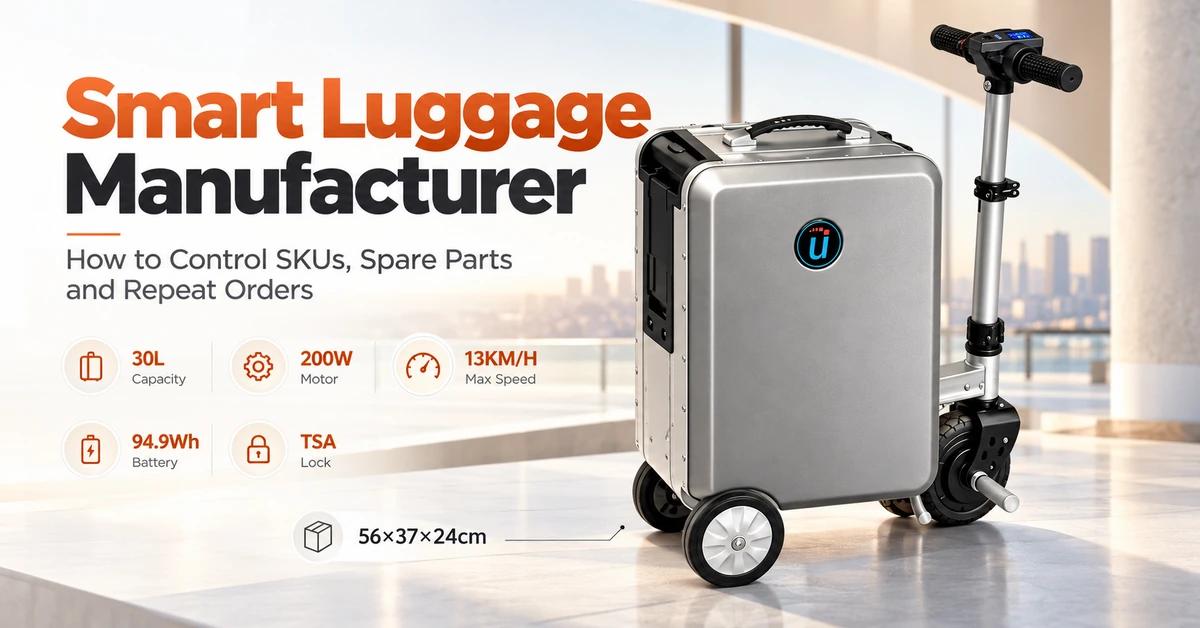
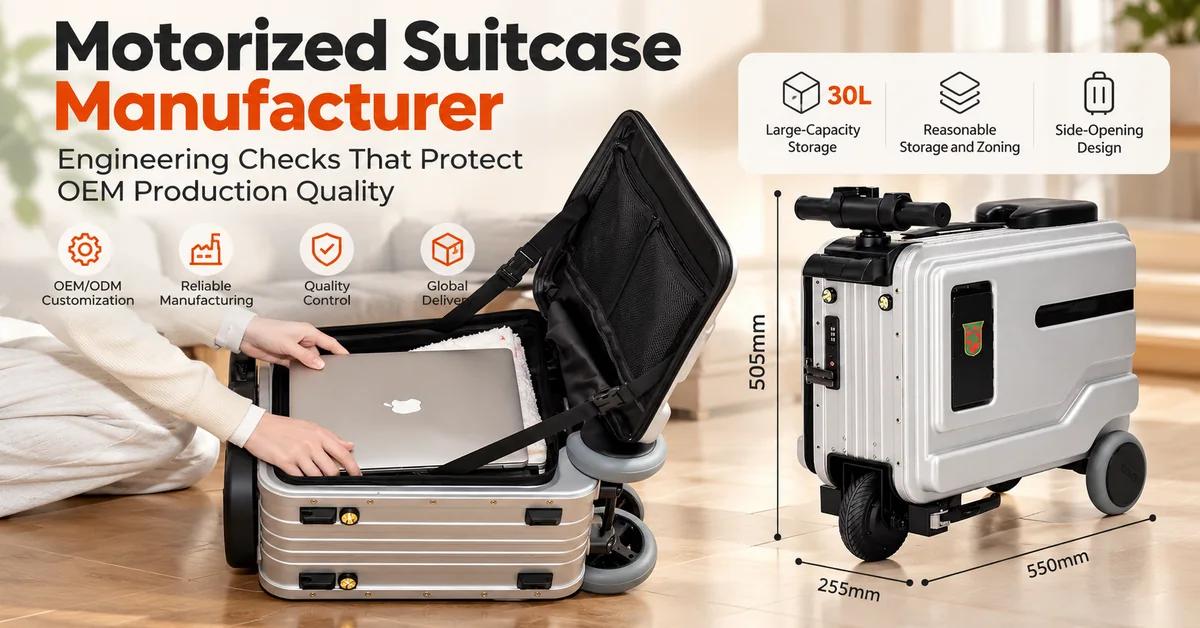
Electric ride-on luggage represents a more specialized category because it integrates a motorized drive system that allows users to operate the luggage as a small powered mobility device under appropriate conditions.
How Electric Luggage Differs From Traditional Suitcases
Traditional luggage primarily focuses on storage, portability, security, and durability.
Smart electric luggage adds electrical and mechanical systems that may provide additional functions.
| Feature | Conventional Luggage | Smart Electric Luggage |
|---|---|---|
| Storage space | Standard compartments | Storage integrated with electronic components |
| Mobility | Manual pulling or pushing | May include powered ride-on mobility |
| Battery | Generally not required | Required for powered functions |
| Charging interface | Usually absent | Available on selected configurations |
| Controls | Mechanical components | May include electronic controls and displays |
| Locking | Mechanical or combination lock | Mechanical or electronic options, depending on model |
| Maintenance | Primarily mechanical | Mechanical and electrical considerations |
| Product development | Conventional luggage engineering | Integrated mechanical and electrical engineering |
Not every electric suitcase includes GPS tracking, Bluetooth connectivity, app control, or digital weighing.
These are separate features that must be confirmed for each product.
Why Does This Difference Matter to B2B Buyers?
A buyer developing a conventional luggage range may prioritize materials, wheels, handles, storage, and exterior design.
An electric luggage project requires additional consideration of motors, batteries, controllers, wiring, electrical components, and their integration with the suitcase structure.
This makes manufacturing capability and technical documentation particularly important.
2. Essential Smart Travel Features Buyers Should Understand
Travel brands should distinguish between features that offer practical customer benefits and technologies that increase complexity without sufficient value.
Electric Ride-On Mobility
Electric ride-on mobility combines suitcase storage with a powered movement function.
It can appeal to customers interested in innovative travel products and mobility convenience in locations where operation is permitted.
Important design considerations include motor output, wheel arrangement, product weight, control accessibility, and rated load.
For B2B buyers, the priority should be reliable and predictable operation rather than the highest advertised speed.
Removable Battery Design
A removable battery can make approved servicing and certain transportation arrangements more practical.
However, battery removability alone does not establish airline acceptance.
Buyers should verify the actual battery configuration, capacity, electrical specifications, and applicable transportation requirements.
USB Charging Interfaces
A built-in charging interface can provide additional convenience when users need to charge compatible electronic devices.
When assessing charging functions, buyers should confirm interface type, electrical output, accessibility, and the approved battery configuration.
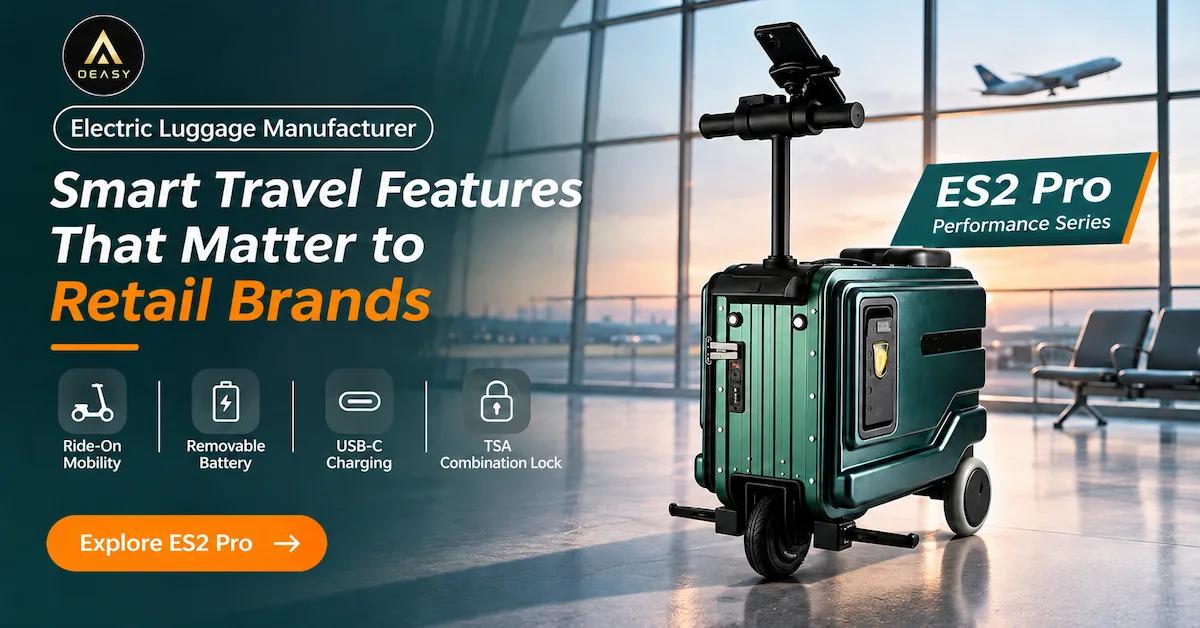
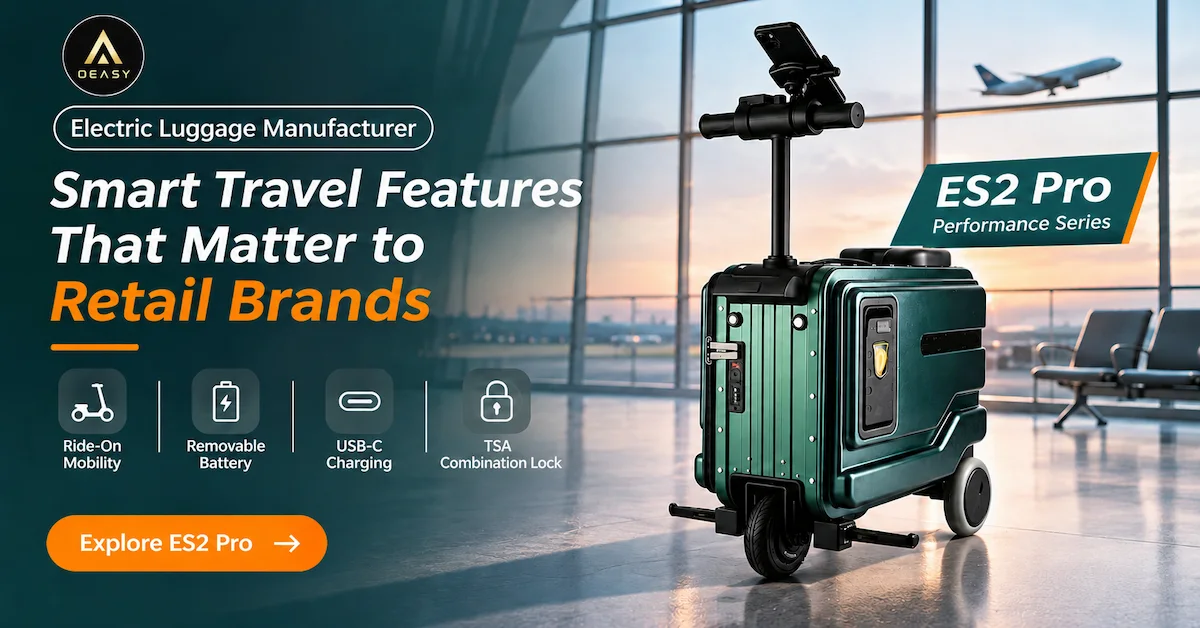
OEASY's ES2 Pro product information identifies USB-C charging among its smart travel functions.
Luggage Security Features
Security remains an important consideration for travel luggage.
Depending on the product, security features may include combination locks, approved travel locks, or electronic locking systems.
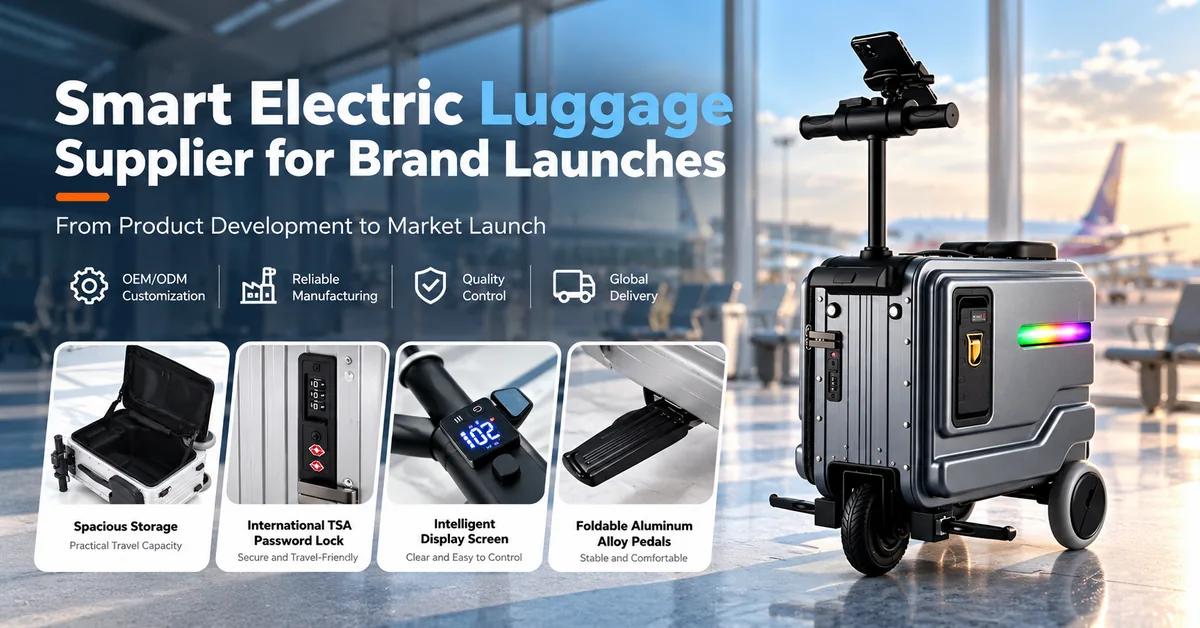
OEASY's ES2 Pro includes a TSA combination lock.
This does not mean every electric luggage product includes a remotely controlled smart lock.
Digital Controls and Displays
Electronic controls can help users operate powered luggage functions.
Selected configurations may incorporate speed indicators, battery status information, and other interface elements.
A useful interface should be understandable, accessible, and appropriate for the intended product.
Tracking and Connected Functions
GPS tracking, Bluetooth connectivity, app-based monitoring, and electronic weighing are examples of technologies found in the broader smart luggage industry.
They may be relevant when evaluating future product concepts, but they are not standard features of every electric suitcase.
Important for OEM buyers: If your target market requires tracking, app connectivity, or a digital weighing system, specify these requirements separately and request an engineering feasibility review.
3. Smart Luggage and the Wider Smart Travel Accessories Market
Smart luggage forms part of a broader range of technologies intended to make travel more convenient.
Understanding related accessories helps brands identify customer needs without unnecessarily integrating every possible feature into one product.
Portable Wi-Fi and Mobile Connectivity
Portable wireless hotspots can help travelers access mobile internet services where suitable coverage is available.
These are generally separate devices rather than built-in components of electric ride-on luggage.
For product planners, the relevant question is whether users need convenient device storage or charging rather than a built-in connectivity module.
Travel Apps and Digital Tools
Travel applications can support itinerary management, translation, navigation, and travel information.
They operate independently of most suitcase functions.
A brand considering app-connected luggage should evaluate whether connectivity provides a meaningful benefit that justifies additional electronics, software support, and maintenance.
Wearable Travel Technology
Smartwatches and other wearable devices may provide notifications, health information, or navigation assistance.
They complement smart luggage but should not be confused with features integrated into the luggage itself.
What This Means for Product Development
Modern travelers may use several technologies during one journey.
A luggage product does not need to incorporate all of them.
Instead, manufacturers and brands should prioritize functions that align with the customer's actual travel habits, budget, and intended environment.
4. What Are the Practical Benefits of Electric Luggage?
Electric luggage can offer product differentiation and user convenience when its features are appropriate to the intended application.
More Flexible Luggage Movement
Ride-on luggage combines storage and powered movement in one product.
This can appeal to customers who value mobility-focused travel accessories.
However, powered riding must be limited to suitable surfaces and locations where operation is allowed.
Convenient Access to Electronic Functions
Selected electric luggage products integrate electronic controls, charging interfaces, and battery access within the suitcase design.
This can reduce the need for additional external accessories.
Product Differentiation for Travel Brands
Electric luggage offers brands an opportunity to expand beyond traditional suitcase categories.
Different design directions, performance levels, exterior finishes, and configurations can support distinct market positioning.
Customization Opportunities
Manufacturing-oriented suppliers may support approved changes to colors, branding, packaging, selected components, and product design.
These options are particularly valuable for private-label brands and distributors developing their own product ranges.
Important Limitations
Product benefits must be evaluated alongside battery maintenance, product weight, serviceability, transportation restrictions, and intended-use conditions.
A smart feature is commercially valuable only when the product delivers a satisfactory experience for its target customers.
5. How to Select Electric Luggage Features for Different Customer Groups
Not every customer needs the same level of product complexity.
A value-focused retailer may prioritize essential functions, while a premium travel brand may emphasize design quality, integrated controls, and refined finishes.
Feature Selection by Market Segment
| Target Market | Primary Customer Needs | Recommended Product Priorities |
|---|---|---|
| Value-focused travel retail | Practicality and affordability | Essential electric mobility and reliable construction |
| Frequent travelers | Convenient operation and functionality | Drive-system performance, battery configuration, storage |
| Premium business travel | Design and user experience | Exterior finish, intuitive controls, product presentation |
| Private-label brands | Differentiation | Branding, colors, packaging and approved configurations |
| Multi-market distributors | Product flexibility | Different platforms and controlled product specifications |
| Product development companies | New product concepts | Engineering integration and ODM feasibility |
Questions Buyers Should Ask Before Selecting Features
-
What specific problem does the feature solve?
-
Which customer segment will value it?
-
Does it increase maintenance requirements?
-
Will it affect product weight or storage capacity?
-
Does the feature require additional testing?
-
Can it be manufactured consistently?
-
Does it support the intended retail price?
-
Are replacement components available?
-
Does it introduce transportation or regulatory restrictions?
-
Can the feature be clearly demonstrated to customers?
These questions help brands avoid spending development resources on unnecessary complexity.
6. Comparing OEASY's Four Electric Luggage Platforms
OEASY offers four smart electric luggage platforms with different product positioning.
The platforms provide overseas buyers with options for developing entry-level, performance-oriented, premium, and flexible product programs.
OEASY Smart Electric Luggage Comparison
| Product Series | Main Positioning | Suitable Buyers | Key Selection Consideration |
|---|---|---|---|
| ES1 Essential | Essential ride-on luggage | Retailers, distributors and private-label brands | Practical functionality and accessible market positioning |
| ES2 Performance | Performance-oriented luggage | Travel brands and premium distributors | Electric mobility and integrated travel features |
| ES3 Executive | Premium business luggage | Executive travel brands and premium retailers | Appearance, materials and integrated functions |
| ES4 Versatile | Flexible multi-function luggage | Multi-market brands and customization projects | Configurations and product versatility |
ES1 Essential: Practical Entry-Level Mobility
The ES1 Essential platform focuses on accessible electric ride-on functionality.
It provides a starting point for retailers and distributors developing value-focused smart travel products.
Available branding and configuration options can be discussed according to project requirements.
ES2 Performance: Integrated Electric Mobility
The ES2 Performance platform is designed around powered mobility and practical luggage features.
OEASY's ES2 Pro includes a removable battery, TSA combination lock, USB-C interface, and ride-on functionality.
Its published specifications include a 250 W brushless motor and approximately 30 L of luggage storage.
The final specifications should be confirmed against the current product configuration.
Explore the ES2 Pro Performance Electric Ride-On Suitcase.
ES3 Executive: Premium Business Positioning
The ES3 Executive platform emphasizes professional appearance, integrated smart functions, and premium product presentation.
It may be appropriate for brands serving executive travelers and higher-end retail customers.
Specific model specifications should be verified before use in technical comparisons or sales materials.
ES4 Versatile: Flexible Product Development
The ES4 Versatile platform supports a multi-function product direction.
Its positioning may suit distributors and brands exploring different market requirements and approved configurations.
Customization feasibility depends on the selected product and project scope.
Product selection recommendation: Match the product platform to the customer's intended use, market position, and required features rather than choosing solely by the number of available functions.
Browse the complete OEASY electric luggage product collection.
7. Technical Specifications an Electric Luggage Manufacturer Should Provide
A product's technical specifications help determine whether it is suitable for its intended market.
Buyers should request model-specific information before sampling and procurement.
Electric Luggage Technical Evaluation Table
| Technical Item | What Buyers Should Verify | Why It Matters |
|---|---|---|
| Motor | Rated power, voltage, motor type | Defines key drive-system characteristics |
| Battery | Voltage, capacity in Wh, removability | Affects power integration and transport review |
| Maximum speed | Published speed and test conditions | Helps evaluate intended operation |
| Rated load | Approved load and conditions | Supports structural selection |
| Product dimensions | External measurements | Affects storage and handling |
| Net weight | Weight of the specified configuration | Influences portability |
| Storage capacity | Usable internal volume | Determines practical luggage function |
| Wheel configuration | Wheel size and arrangement | Affects handling |
| Controls | Operating modes and interface | Determines user accessibility |
| Lock system | Approved locking features | Supports luggage security |
| Charging interface | Connector and electrical output | Determines device compatibility |
| Housing materials | Approved materials and finishes | Influences structure and appearance |
Battery Capacity Does Not Equal Guaranteed Riding Range
Battery energy is commonly expressed in watt-hours.
However, actual riding range depends on operating conditions, load, motor efficiency, speed, surface, and other factors.
Buyers should request testing conditions when comparing range claims.
Motor Power Is Only One Part of Performance
Motor wattage provides useful technical information, but ride-on performance also depends on the controller, drive configuration, wheels, weight distribution, and operating conditions.
For a reliable purchasing decision, evaluate the complete system.
8. Why Manufacturing Quality Matters More Than Feature Quantity
Adding electronic functions increases the importance of product engineering and quality control.
An electric luggage manufacturer should evaluate mechanical structures, battery placement, controls, and luggage functionality as a coordinated product system.
Mechanical and Electrical Integration
The motor, controller, battery, wheels, and structural components must be incorporated without compromising the approved luggage design.
Engineering considerations include load distribution, component access, electrical connections, and assembly requirements.
Precision Manufacturing
OEASY describes manufacturing support involving:
-
CNC precision machining.
-
Injection molding.
-
Metal fabrication.
-
Surface treatment.
-
Product assembly.
-
Engineering development.
These processes support the manufacture and integration of approved components.
Explore OEASY's manufacturing capabilities.
Quality Control and Product Validation
OEASY's stated quality workflow includes incoming material, component, assembly, final, and pre-shipment inspections.
Relevant testing can also address battery functions, structural loading, and product durability according to the approved validation plan.
Buyers should request the inspection criteria and relevant reports for their selected product.
Why This Matters to Wholesale Buyers
Manufacturing consistency affects customer experience, warranty expectations, and repeat-order quality.
A product that performs well during a demonstration must also meet the agreed specifications across subsequent production batches.
9. Can Electric Luggage Be Used on International Flights?
Airline acceptance is one of the most important issues for electric ride-on luggage.
Electric luggage with a removable battery is not automatically approved for passenger flights.
Ordinary smart baggage and motorized ride-on suitcases may be treated differently under applicable rules.
The International Air Transport Association (IATA) provides passenger baggage and lithium battery guidance, while individual airlines establish their own acceptance policies.
Some airlines explicitly prohibit powered ride-on luggage, including products with removable batteries.
Four Requirements Buyers Should Check
Battery configuration: Confirm battery type, capacity, removability, and applicable documentation.
Passenger baggage rules: Review the policies of the airlines relevant to the intended market.
Commercial shipping: Confirm requirements for transporting products and batteries through the selected logistics channels.
Riding permission: Determine whether powered operation is permitted in the intended location.
Airport terminals, hotels, stations, and other properties may apply their own restrictions.
Manufacturers and distributors should not describe a product as universally airline-approved or suitable for unrestricted airport riding without appropriate evidence.
10. OEM/ODM Electric Luggage: Turning Smart Features Into Products
For brands developing custom electric luggage, successful manufacturing requires careful coordination between product design, electrical engineering, mechanical integration, and production planning.
OEM Electric Luggage Manufacturing
OEM projects generally begin with an existing product platform.
Depending on the approved project, customization may include:
-
Brand logos.
-
Exterior colors.
-
Packaging.
-
Selected accessories.
-
Approved component configurations.
-
Product labeling.
This approach may suit importers and private-label businesses seeking to establish a branded product range.
ODM Electric Luggage Development
ODM services are relevant when a buyer requires more substantial product engineering.
Possible projects may involve structural changes, new enclosures, electronic integration, display placement, battery compartment development, or other approved modifications.
OEASY's Eight-Stage Development Process
OEASY describes the following workflow:
-
Product Concept
-
Industrial Design
-
Engineering Development
-
Prototype
-
Mold Manufacturing
-
Testing
-
Mass Production
-
Global Delivery
Not every existing-platform customization project requires new tooling.
Development requirements, costs, MOQ, and lead times should be confirmed for the specific project.
Learn more about OEASY's OEM/ODM development process.
11. How to Evaluate an Electric Luggage Manufacturer for Wholesale Orders
Choosing a manufacturer involves both product selection and commercial planning.
For long-term B2B sourcing, buyers should evaluate technical capabilities, product documentation, quality control, customization readiness, and after-sales arrangements.
Product and Manufacturing Evaluation
Request current technical specifications, product samples, information about relevant manufacturing processes, and applicable validation records.
Confirm that the sample represents the intended production configuration.
Commercial Evaluation
Discuss MOQ, expected production schedule, customization costs, packaging, delivery terms, and quotation scope.
Avoid comparing unit prices when the quoted configurations are different.
After-Sales Evaluation
Clarify warranty arrangements, replacement-part availability, technical troubleshooting, and procedures for defective products.
Electric luggage may require additional servicing compared with conventional luggage.
A Practical Purchasing Sequence
Start by defining the target market and customer needs.
Then select the appropriate product platform, request a technical review, evaluate samples, approve specifications, and establish production and quality requirements.
This process helps minimize uncertainty before bulk procurement.
12. Why Consider OEASY for Electric Luggage Manufacturing?
OEASY is a China-based smart electric luggage brand supported by Hangzhou UNIWISE International Co., Ltd. for international business coordination and Ningbo UNIWISE Precision Machinery Co., Ltd. for engineering and manufacturing.
The business connects product development, precision manufacturing, assembly coordination, quality processes, and international project services.
Product Platform Options
OEASY offers ES1 Essential, ES2 Performance, ES3 Executive, and ES4 Versatile product directions.
These platforms support different customer groups and market positioning strategies.
Engineering and Manufacturing Support
The company describes integrated engineering, CNC machining, injection molding, metal fabrication, surface finishing, and assembly resources.
OEM/ODM Customization
Brands can discuss approved exterior customization, packaging, component options, and product development requirements.
International B2B Cooperation
Overseas buyers can communicate their product needs, estimated quantities, intended market, and delivery expectations for a project-specific review.
Explore OEASY's company background to learn more about its manufacturing and international project structure.
13. Request an Electric Luggage Product Consultation
Whether you are introducing electric luggage into an existing travel accessories range or planning a new private-label product, the first step is to define the features your customers genuinely need.
A useful inquiry should include:
-
Target sales market and distribution channels.
-
Preferred product platform.
-
Required smart functions.
-
Expected order quantity.
-
Branding and packaging requirements.
-
Technical or customization priorities.
-
Target retail price positioning.
-
Expected launch or delivery schedule.
-
Applicable documentation requirements.
OEASY can review your product direction and discuss available platforms, customization feasibility, and potential next steps.
Looking for an electric luggage manufacturer for your travel brand or wholesale business?
Explore OEASY Electric Luggage Products
Learn About OEM/ODM Customization
Request a Product Consultation or Quotation
14. Frequently Asked Questions About Electric Luggage Manufacturing
1. What is electric luggage?
Electric luggage is luggage incorporating powered electrical functions, which may include charging, electronic controls, or motorized movement. Electric ride-on luggage combines a suitcase with an integrated drive system.
2. What does an electric luggage manufacturer do?
An electric luggage manufacturer supports the engineering and production of luggage with electrical or powered mobility systems. Depending on its capabilities, services may include product design, mechanical fabrication, electronics integration, assembly, testing, and OEM/ODM customization.
3. What smart features are most useful in electric luggage?
Useful features depend on customer needs. Powered mobility, removable batteries, practical controls, charging interfaces, and secure storage may provide value. Tracking, app connectivity, and digital weighing require separate product-specific verification.
4. Is all smart luggage motorized?
No. Some smart luggage incorporates electronic locks, charging functions, or tracking technology without powered movement. Ride-on electric luggage is a specialized category with additional mechanical and electrical requirements.
5. What should buyers check when comparing electric luggage batteries?
Confirm rated voltage, capacity in Wh, removability, charging requirements, compatibility, and relevant testing documentation. Buyers should also review market and transportation restrictions.
6. Can electric luggage be customized with a private-label brand?
Yes. Existing electric luggage platforms may support approved logo placement, colors, packaging, accessories, and selected configurations. More extensive changes may require ODM engineering and additional validation.
7. Does OEASY offer different electric luggage models?
Yes. OEASY offers four product directions: ES1 Essential, ES2 Performance, ES3 Executive, and ES4 Versatile. Each has a different market positioning, and specific configurations should be confirmed before purchasing.
8. Is electric ride-on luggage allowed on airplanes?
Not universally. Airline restrictions vary, and some carriers prohibit rideable motorized luggage even with removable batteries. Buyers should verify current airline policies and the exact product classification before making travel-compatibility claims.
9. What affects electric luggage manufacturing costs?
Costs depend on mechanical and electrical components, battery configuration, materials, customization, tooling, production quantity, quality requirements, packaging, and logistics. A project-specific quotation is required for accurate pricing.
10. How can I request an electric luggage manufacturing quotation from OEASY?
Provide your preferred product platform, required features, target country, expected order quantity, customization needs, and delivery expectations through the OEASY contact page. The team can review the requirements and discuss suitable options.
Conclusion
The development of smart travel accessories is creating opportunities for luggage brands to introduce products that combine traditional storage with useful electronic and mobility functions.
However, successful electric luggage products require more than adding technology. Buyers must consider which features solve real customer problems, how electrical and mechanical systems are integrated, and whether the product can be manufactured, serviced, and supplied consistently.
Choosing the right electric luggage manufacturer is therefore essential for brands seeking to develop competitive and practical smart travel products.
OEASY offers four electric luggage platforms supported by engineering development, precision manufacturing, quality coordination, and OEM/ODM customization services.
By matching smart features to customer needs and establishing clear technical and commercial requirements, importers and private-label brands can make more informed product development decisions.
Planning your next electric luggage product line? Contact OEASY to discuss product selection, customization opportunities, and a project-specific manufacturing quotation.