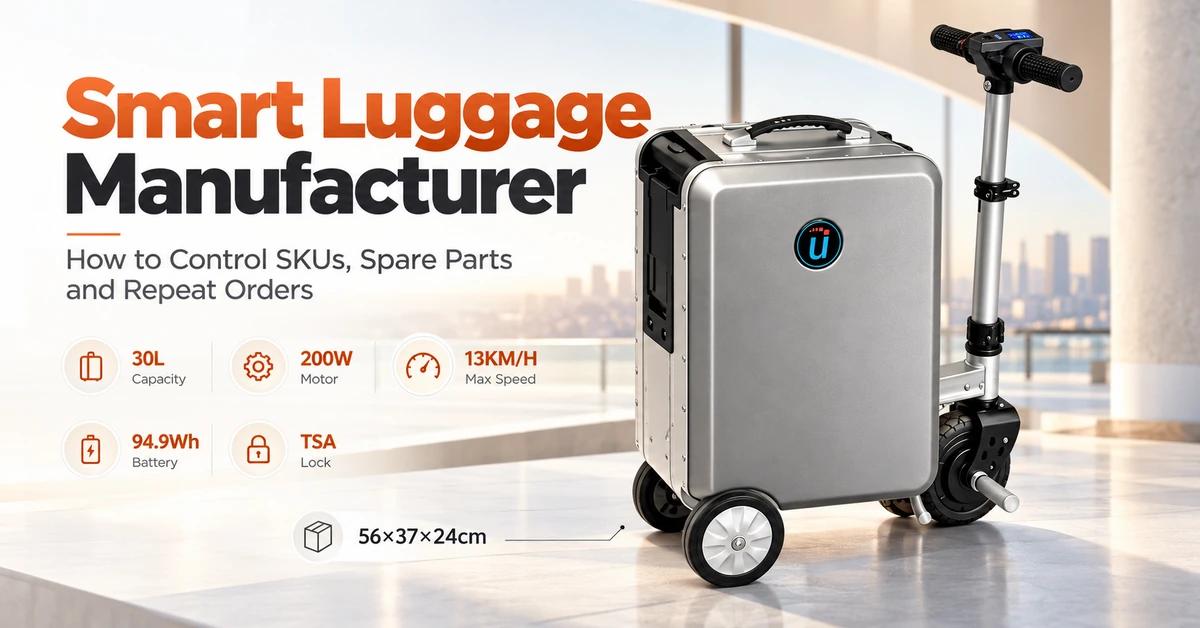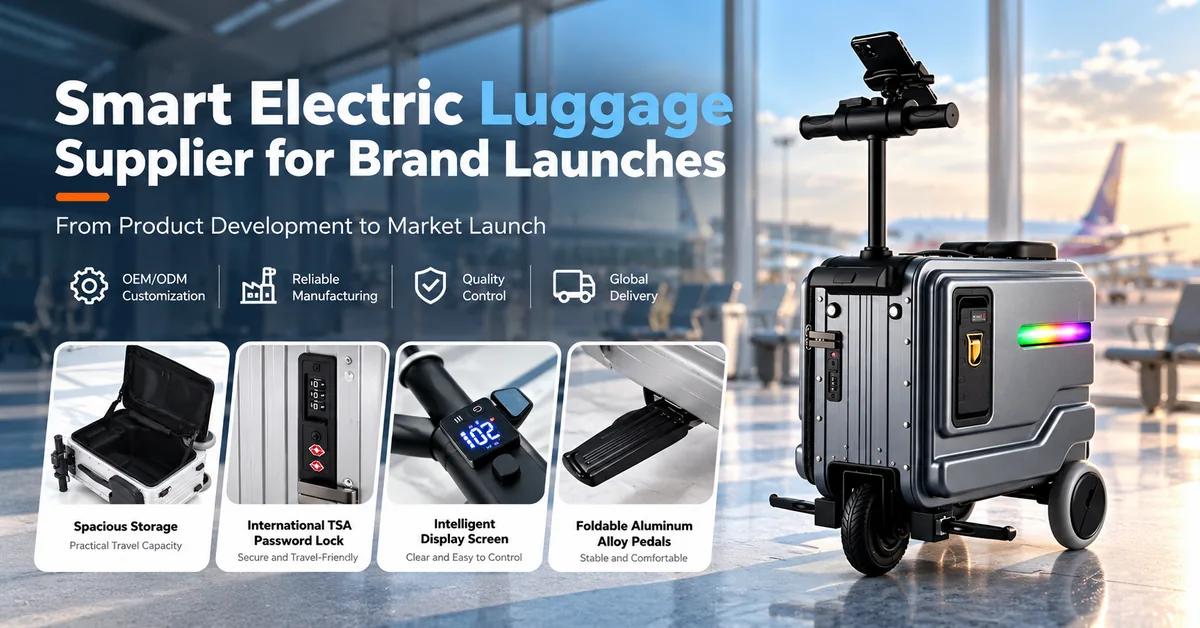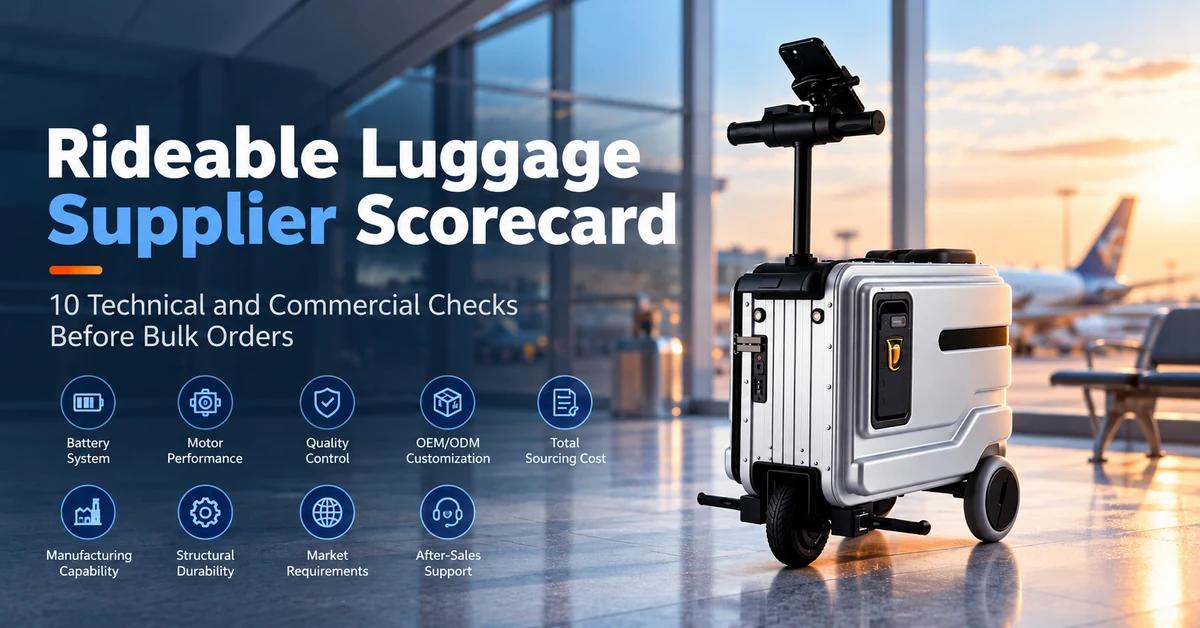
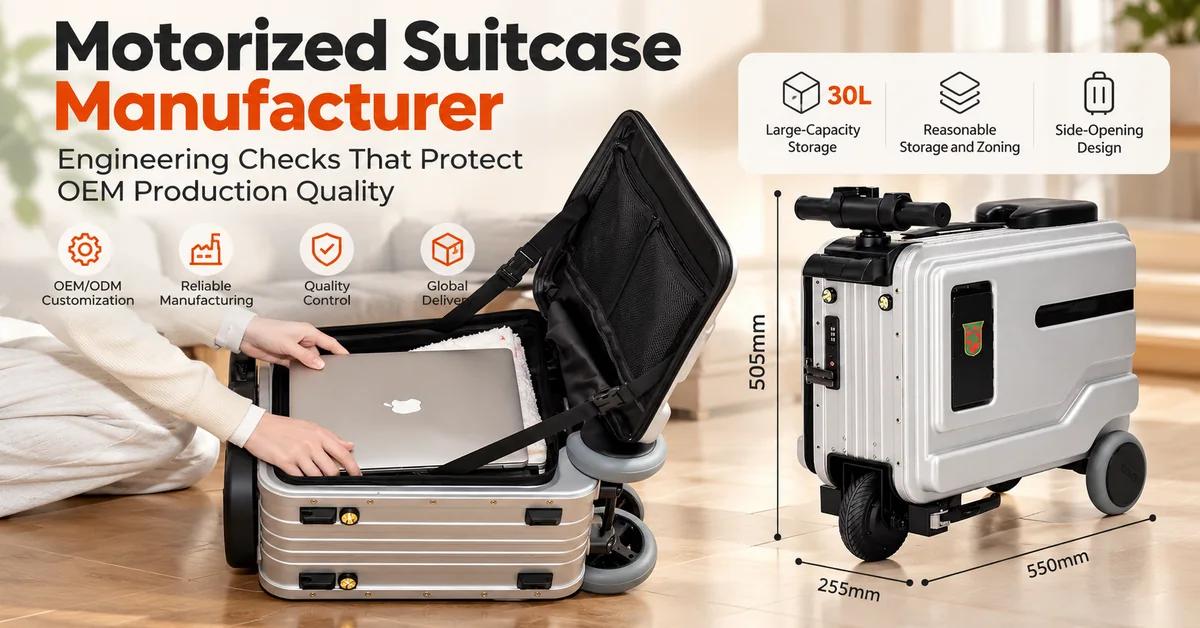
Choosing a reliable motorized suitcase manufacturer requires more than comparing motor wattage, battery capacity, or product appearance. For overseas luggage brands, wholesale importers, and OEM buyers, manufacturing quality depends on how mechanical structures, electrical components, mobility systems, and luggage functions are engineered to work together.
A motorized suitcase combines traditional luggage storage with powered mobility technology. Its motor, controller, battery, wheels, frame, and user interface must operate as an integrated system without compromising the product's intended storage and handling functions.
The key to reliable motorized suitcase manufacturing is coordinated engineering, validated prototypes, controlled component production, and documented quality inspections before bulk delivery.
This guide explains the engineering decisions, manufacturing processes, and quality controls international buyers should evaluate when developing an OEM or ODM motorized luggage product.
OEASY supports smart electric luggage projects through product development, precision manufacturing, component integration, quality coordination, and international B2B services.
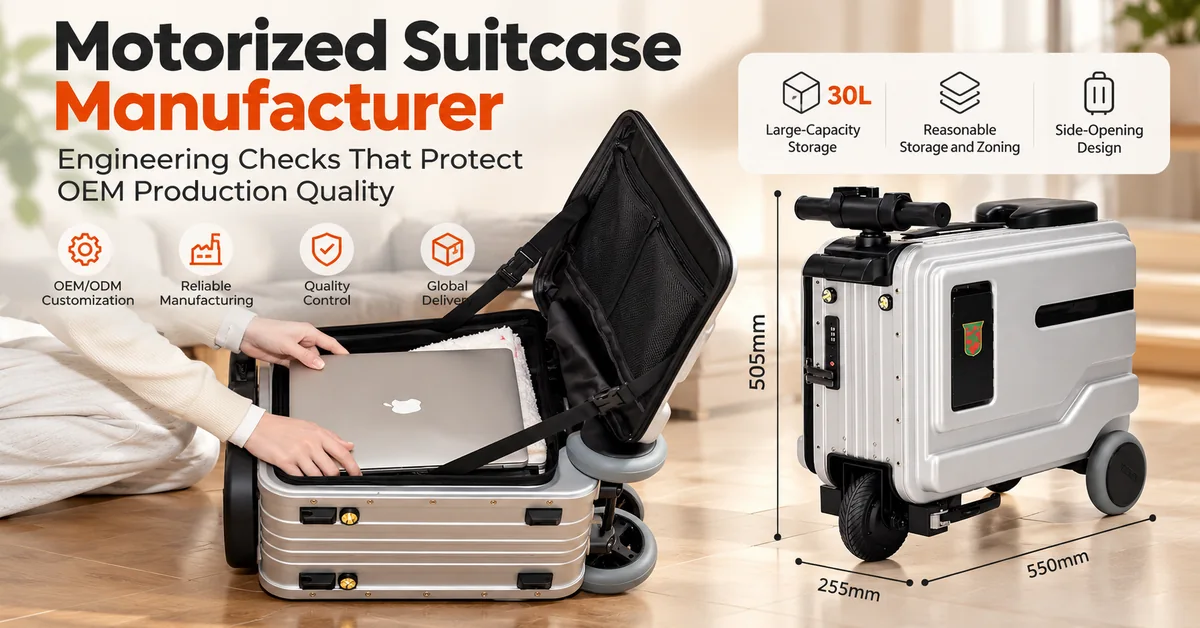
1. Why Motorized Suitcase Manufacturing Requires Integrated Engineering
A motorized suitcase is not simply a conventional suitcase fitted with an electric motor.
Its construction involves several interconnected systems, each affecting product performance, user experience, and manufacturing consistency.
Mechanical Structure and Load Distribution
The suitcase structure must accommodate storage contents, drive-system components, and the loads associated with its intended operating mode.
Important engineering considerations include frame geometry, wheel mounting, handle connections, component positioning, and structural reinforcement.
Poorly coordinated mechanical design can create assembly difficulties, uneven load distribution, or reduced component serviceability.
Electrical and Drive-System Integration
The motor, battery, controller, wiring, and charging interfaces must operate as a coordinated electrical system.
Engineers need to consider rated power, voltage compatibility, current demands, control behavior, component placement, and maintenance access.
Luggage Functionality
Motorized mobility must coexist with practical luggage storage.
Internal compartments, zippers, locking systems, exterior handles, and electronic housings must be arranged so the product remains functional as luggage.
Who Benefits From Integrated Manufacturing?
| B2B Buyer | Manufacturing Requirement | Primary Objective |
|---|---|---|
| Luggage brands | Integrated product development | Consistent product quality |
| OEM importers | Approved configurations | Repeatable bulk production |
| ODM product developers | Mechanical and electrical engineering | Customized product development |
| Wholesale distributors | Standardized product specifications | Reliable supply |
| Premium travel brands | Structural and visual refinement | Product differentiation |
| Technical purchasing teams | Documented validation | Reduced sourcing risk |
Buyers seeking guaranteed airline acceptance, unrestricted riding permissions, or all-terrain operation must separately validate those requirements. Motorized suitcases should not be assumed suitable for every transportation environment.
2. How Does Drive-System Integration Affect Motorized Suitcase Performance?
Drive-system integration is a critical aspect of electric ride-on suitcase manufacturing.
Motor performance depends not only on the motor itself but also on its relationship with the controller, battery, wheel configuration, product weight, and intended load.
Motor Selection and Power Requirements
A motorized suitcase manufacturer should select or evaluate a drive system according to the intended product specification.
Important considerations include:
-
Rated motor power.
-
Operating voltage.
-
Torque requirements.
-
Speed-control characteristics.
-
Product and rider load.
-
Wheel diameter and configuration.
-
Intended operating surfaces.
-
Thermal and electrical operating limits.
Motor wattage alone does not determine acceleration, operating range, or load-handling performance.
Example: OEASY ES2 Pro Drive Configuration
OEASY's published ES2 Pro information identifies a 36 V, 250 W brushless motor, a removable 93.6 Wh battery, and a stated maximum operating speed of up to 13 km/h.
These figures provide a useful reference for understanding a specific performance-oriented electric luggage configuration.
However, actual operating results depend on conditions, and current model specifications should be confirmed before procurement.
Buyers can examine the ES2 Pro Performance Electric Ride-On Suitcase for product design and configuration information.
Motor Controller and User Interface Integration
The electronic controller manages how the drive system responds to user commands.
Depending on the product, the interface may include acceleration controls, speed settings, status indicators, and other operating functions.
During engineering development, manufacturers should evaluate control accessibility, wiring connections, operating behavior, and system compatibility.
Wheel Design and Structural Connection
Wheel design influences stability, maneuverability, and handling.
Engineers should review wheel placement, mounting structures, load transfer, and clearance around the housing.
Changes to wheel dimensions or mounting positions may also affect the product's geometry and handling characteristics.
Engineering takeaway: A drive system should be validated as part of the complete suitcase assembly rather than evaluated solely through individual component specifications.
3. Battery Integration: A Critical Design Consideration for Electric Luggage
Battery configuration affects electrical performance, internal space allocation, product weight, maintenance access, and transportation planning.
For OEM motorized luggage, battery engineering must be coordinated with the overall product structure.
Battery Positioning and Enclosure Design
Engineers should evaluate battery placement according to the product's structural and electrical requirements.
The battery compartment should be assessed for:
-
Mechanical support.
-
Electrical connection integrity.
-
Accessibility for approved servicing.
-
Protection from foreseeable mechanical interference.
-
Suitable routing of cables and connectors.
-
Compatibility with the enclosure and adjacent components.
For removable battery designs, the removal mechanism should also be included in the product validation process.
Battery Capacity and Power Compatibility
Lithium-ion battery capacity is commonly expressed in watt-hours (Wh).
The battery's rated voltage, capacity, and electrical characteristics must be compatible with the selected system.
A higher Wh rating does not automatically guarantee a proportional increase in riding range because operating conditions and system efficiency also affect energy consumption.
Battery Documentation for International Buyers
Before approving a product configuration, request applicable battery specifications, test records, and transportation documents.
Different destination markets and shipping arrangements may have different requirements.
Importantly, passenger airline restrictions should be reviewed separately from commercial cargo documentation.
A removable battery does not automatically make motorized ride-on luggage acceptable on every flight.
4. Technical Specifications Buyers Should Confirm Before OEM Production
A clearly documented specification helps prevent disagreements between product developers, manufacturers, and purchasing teams.
The following technical checklist can form the basis of an OEM project brief.
Motorized Suitcase Technical Specification Checklist
| Component | Technical Information to Confirm | Engineering Purpose |
|---|---|---|
| Motor | Type, voltage, rated power | Drive-system compatibility |
| Controller | Control functions and operating modes | Predictable operation |
| Battery | Chemistry, voltage, Wh rating, removability | Power and maintenance requirements |
| Wheel system | Size, arrangement, mounting design | Handling and load distribution |
| Frame | Material and structural construction | Load-bearing suitability |
| Housing | Material, dimensions, finishing | Protection and product appearance |
| Storage | Usable capacity and compartment layout | Luggage functionality |
| User interface | Controls and display configuration | User operation |
| Charging | Charging input and connector specification | Electrical compatibility |
| Rated load | Approved operating load and conditions | Structural evaluation |
| Product weight | Approved net weight | Handling and logistics |
| Operating environment | Suitable surfaces and conditions | Appropriate product application |
The approved specification should identify the exact product version, component configuration, and any agreed customization.
Why Dimensional Accuracy Matters
Motorized luggage components must fit within a compact enclosure.
Dimensional inconsistencies can affect wheel mounting, shell alignment, battery compartment assembly, handle movement, and other functions.
Manufacturing tolerances should be defined according to the actual component design and assembly requirements.
Where appropriate, inspection records can help verify that production components remain within approved limits.
5. Manufacturing Processes Behind a Motorized Suitcase
A manufacturing-oriented supplier should understand how component production affects the assembled product.
OEASY's stated manufacturing capabilities include CNC precision machining, injection molding, metal fabrication, surface treatment, product assembly, and engineering support.
CNC Precision Machining
CNC machining supports the manufacture of approved metal components requiring dimensional control.
Potential applications include structural brackets, connectors, and functional mounting parts.
Consistent machining can help maintain repeatable component dimensions across production batches.
Injection Molding
Injection molding supports the manufacture of plastic housing and enclosure components.
Mold design should account for component geometry, material behavior, assembly features, and the intended production process.
For customized designs, changes to the enclosure may require tooling evaluation.
Metal Fabrication
Metal fabrication processes support structural elements such as frames, brackets, and supporting assemblies.
Material and fabrication methods should correspond to the approved engineering requirements.
Surface Treatment
Surface preparation and finishing contribute to exterior appearance and product consistency.
For private-label projects, approved colors, surface effects, and finishes may also support brand differentiation.
Mechanical and Electrical Assembly
Assembly combines the luggage housing, structural components, drive system, electrical connections, and functional accessories.
Controlled assembly procedures help ensure that the delivered configuration corresponds to the approved product.
Learn more about OEASY's precision manufacturing and assembly capabilities.
6. From Engineering Prototype to Mass Production
Prototype development provides an opportunity to identify product issues before significant production investment.
OEASY describes an eight-stage OEM/ODM workflow covering product concept, industrial design, engineering development, prototype creation, mold manufacturing, testing, mass production, and global delivery.
Stage 1: Define the Product Requirements
Establish the intended market, user profile, mechanical requirements, electrical specifications, and customization objectives.
Stage 2: Develop the Industrial Design
Review the product's exterior design, user interface, materials, and functional layout.
Stage 3: Complete Engineering Development
Coordinate structural components, drive-system integration, battery placement, enclosure construction, and manufacturability.
Stage 4: Produce and Evaluate a Prototype
Prototype evaluation should address functional operation, assembly quality, structural suitability, and the approved design requirements.
Stage 5: Prepare Production Tooling
Where custom parts require new tooling, tool design should follow the approved engineering drawings and component specifications.
Stage 6: Perform Product Validation
Testing should follow the agreed validation plan, using defined methods and acceptance criteria.
Stage 7: Organize Mass Production
Production should follow the approved configuration, inspection requirements, and manufacturing instructions.
Stage 8: Coordinate International Delivery
Complete the agreed packaging, shipment documentation, and delivery arrangements.
Not every project requires new tooling. Existing-platform OEM customization may involve fewer engineering stages than a substantially new ODM design.
For additional information, explore OEASY's OEM/ODM manufacturing process.
7. Quality Control Requirements for Reliable Motorized Luggage Production
Consistent product quality requires inspection throughout the manufacturing process.
Finished-product inspection alone may not identify the source of problems introduced during component manufacturing or assembly.
Four Essential Quality Control Stages
Incoming Quality Control (IQC): Reviews incoming materials and components against defined requirements.
In-Process Quality Control (IPQC): Checks relevant manufacturing and assembly operations.
Final Quality Control (FQC): Evaluates finished products against the approved specification.
Outgoing Quality Control (OQC): Supports pre-shipment inspection and order verification.
OEASY identifies these stages in its published quality control workflow.
Recommended Validation Matrix
| Validation Area | Typical Check | Evidence Buyers Should Request |
|---|---|---|
| Drive system | Motor and control functionality | Approved functional test records |
| Battery | Charging and defined battery checks | Model-specific test documentation |
| Structural assembly | Load-bearing requirements | Applicable load test records |
| Wheel installation | Assembly and operating behavior | Inspection or functional records |
| Housing | Fit, finish, and assembly | Visual and dimensional criteria |
| Locks and handles | Functional operation | Approved inspection records |
| Durability | Agreed mechanical tests | Defined test method and results |
| Finished product | Configuration and appearance | Final inspection report |
| Shipment | Packaging and order conformity | Pre-shipment inspection records |
Drop testing and other specific validation activities should be performed according to the approved project requirements.
A buyer should not assume that every model has undergone the same testing procedure or achieved the same certification.
Why Production Traceability Matters
When defects occur, manufacturers and buyers benefit from identifying the relevant production configuration, component version, and inspection history.
For repeat orders, maintaining approved specifications and change records helps reduce inconsistencies between shipments.
8. Comparing OEASY Motorized Suitcase Platforms for OEM Projects
Different luggage platforms provide different starting points for engineering and commercial planning.
OEASY offers four smart electric luggage directions designed for distinct target markets.
Product Platform Comparison
| Platform | Product Positioning | Suitable Buyers | Engineering Focus |
|---|---|---|---|
| ES1 Essential | Value-focused ride-on luggage | Wholesalers and private-label retailers | Practical functions and controlled product complexity |
| ES2 Performance | Performance-oriented electric luggage | Travel brands and premium distributors | Drive performance and user functionality |
| ES3 Executive | Premium business-oriented luggage | Executive and premium travel brands | Design, integrated controls, and finishes |
| ES4 Versatile | Flexible multi-function platform | Multi-market brands and ODM buyers | Configuration flexibility and structural integration |
These are platform-level distinctions rather than universal technical specifications.
Which Platform Is Suitable for Your Development Project?
ES1: Standardized Entry-Level Product Programs
ES1 may be relevant for wholesale customers seeking essential electric luggage functionality and accessible market positioning.
ES2: Performance-Oriented OEM Projects
ES2 is particularly relevant when buyers want to discuss motor performance, battery configuration, and practical ride-on functionality.
ES3: Premium Product Development
ES3 is suitable for discussions around executive styling, user interface integration, and premium product presentation.
ES4: Flexible ODM Development
ES4 may provide a starting point for projects requiring flexible configurations or differentiated product concepts.
Final platform selection should reflect the target market, product requirements, development budget, and approved technical specification.
Explore all OEASY motorized luggage products.
9. How OEM/ODM Customization Affects Engineering Cost and Production Risk
Customization can create product differentiation, but it may also introduce engineering and manufacturing complexity.
OEM: Customization Based on Existing Platforms
OEM projects commonly involve approved changes to branding, colors, packaging, accessories, or selected configurations.
Using an existing platform may reduce the amount of new engineering work required.
However, buyers should still approve the exact configuration and relevant samples.
ODM: Custom Product Engineering
ODM development may involve new external structures, electronic integration, battery compartment modifications, internal layouts, or component housings.
These changes can require additional engineering, tooling, testing, and documentation.
Key Cost and Risk Factors
| Project Factor | Potential Cost Impact | Risk Management Approach |
|---|---|---|
| Motor configuration changes | Component and engineering costs | Confirm system compatibility |
| Battery modifications | Electrical and validation costs | Review applicable battery requirements |
| New housing design | Tooling and development costs | Approve drawings and prototypes |
| Structural redesign | Fabrication and testing costs | Define load requirements |
| Custom electronics | Engineering and component costs | Validate functionality |
| Surface customization | Finishing and setup costs | Approve appearance samples |
| Packaging changes | Material and preparation costs | Approve packaging specifications |
Buyers should distinguish one-time development costs from recurring unit production costs.
MOQ, sampling fees, tooling expenses, production capacity, and lead times depend on the specific project and require written confirmation.
10. International Market Requirements and Intended Applications
Motorized suitcases may be considered for various travel, retail, and controlled-use applications.
Potential applications include business travel products, travel retail demonstrations, hospitality projects, and approved private-facility mobility scenarios.
However, suitable applications depend on the individual product and permitted operating conditions.
Product Compliance and Battery Documentation
Buyers should identify the requirements applicable to the intended destination market.
Depending on the configuration, documentation associated with battery testing, CE, FCC, RoHS, or UN38.3 may be relevant.
OEASY states that testing and certification status are reviewed by model and project. These references should not be interpreted as confirmation that every product has obtained every certification.
Airline Restrictions
Motorized ride-on luggage must not automatically be described as airline-approved.
The International Air Transport Association (IATA) provides guidance on battery-powered baggage and small mobility devices. Airline-specific restrictions may be stricter.
For example, British Airways explicitly prohibits electric-powered ride-on baggage from both cabin and checked baggage.
A removable battery or a rating below 100 Wh does not override such restrictions.
Marketing materials should distinguish battery specifications, commercial shipping requirements, passenger baggage acceptance, and permission to ride in particular locations.
11. Why Consider OEASY as Your Motorized Suitcase Manufacturer?
OEASY is a China-based smart electric luggage brand supported by Hangzhou UNIWISE International Co., Ltd. for international business coordination and Ningbo UNIWISE Precision Machinery Co., Ltd. for engineering and manufacturing.
Its business model combines product development, precision manufacturing resources, assembly coordination, quality control, and international project support.
Engineering and Manufacturing Capabilities
OEASY describes support for mechanical structures, electrical integration, CNC machining, injection molding, metal fabrication, surface treatment, and product assembly.
OEM/ODM Development Support
Its development process connects product requirements with industrial design, prototypes, engineering evaluation, tooling, testing, and production.
Product Platform Selection
The ES1, ES2, ES3, and ES4 platforms provide different starting points for wholesale procurement and customized product development.
Quality Coordination
The stated quality workflow covers incoming materials, manufacturing processes, finished products, and outgoing inspection.
International Project Communication
Overseas buyers can discuss technical requirements, selected product configurations, customization expectations, and delivery planning through the international business team.
Explore OEASY's company background and manufacturing support.
12. What Should Buyers Include in a Motorized Suitcase OEM Inquiry?
A detailed project brief makes it easier for manufacturers to evaluate technical feasibility and prepare relevant proposals.
Include the following information:
-
Target sales country and customer segment.
-
Intended application and operating environment.
-
Preferred motorized luggage platform.
-
Estimated purchasing quantity.
-
Motor and battery requirements.
-
Target dimensions, weight, and storage capacity.
-
Structural and appearance customization.
-
Required testing and documentation.
-
Target production and delivery schedule.
-
Packaging, warranty, and spare-parts expectations.
The supplier can then review the requested configuration, identify areas requiring engineering evaluation, and discuss a suitable development or procurement process.
Start Your Motorized Luggage Manufacturing Project
Looking for a motorized suitcase manufacturer with engineering and OEM/ODM support?
OEASY can review your technical requirements, target market, customization scope, and estimated purchasing volume to discuss potential product platforms and project-specific manufacturing arrangements.
Explore Motorized Suitcase Products
Review OEM/ODM Manufacturing Capabilities
Request a Motorized Suitcase OEM Quotation
13. Frequently Asked Questions About Motorized Suitcase Manufacturing
1. What does a motorized suitcase manufacturer do?
A motorized suitcase manufacturer supports the production of luggage with integrated electric mobility systems. Depending on its capabilities, services may include product engineering, mechanical component manufacturing, electrical integration, assembly, testing, and OEM/ODM customization.
2. What is the difference between motorized suitcase manufacturing and conventional luggage manufacturing?
Motorized luggage requires additional coordination of motors, batteries, controllers, wheels, electrical connections, and structural loads. Conventional luggage manufacturing generally does not involve the same powered drive-system integration.
3. Can motor power be customized for an OEM motorized suitcase?
Motor changes may be considered during engineering development, but feasibility depends on electrical compatibility, controller configuration, battery requirements, structural design, and product validation. Buyers should not assume that motor power can be changed independently.
4. What materials are commonly used in electric ride-on suitcases?
Materials may include aluminum alloys for certain structural components and engineering plastics such as polycarbonate for housings. Actual material selection depends on the model's design, load requirements, weight objectives, and manufacturing processes.
5. How should buyers evaluate battery integration?
Review battery capacity, voltage, electrical compatibility, physical placement, removal mechanism, charging requirements, applicable protection features, and relevant testing documents. The complete battery installation should be assessed within the approved product design.
6. What quality control procedures are important during production?
Important procedures include incoming component inspection, in-process quality checks, functional testing, appropriate structural validation, finished-product inspection, and pre-shipment verification. Test methods should be agreed for the specific configuration.
7. Can a manufacturer develop a completely customized motorized suitcase?
An ODM-capable manufacturer may support new industrial design, structural development, electronics integration, prototypes, tooling, and production. Development feasibility and costs should be confirmed through a project-specific engineering review.
8. What determines the MOQ and production lead time?
MOQ and lead time depend on the selected platform, customization scope, tooling requirements, component availability, validation procedures, and production arrangements. Buyers should request current terms for the actual project.
9. Are motorized suitcases accepted by all airlines?
No. Some airlines prohibit electric-powered ride-on baggage regardless of battery removability. Buyers must verify current airline policies and distinguish passenger baggage acceptance from battery documentation and commercial cargo arrangements.
10. How can I request a manufacturing quotation from OEASY?
Share your intended market, product platform, technical requirements, customization needs, expected order quantity, and delivery expectations through the OEASY contact page. The team can review the project and discuss relevant product and manufacturing options.
Conclusion
Selecting the right motorized suitcase manufacturer requires a detailed understanding of mechanical design, electrical integration, production processes, quality control, and international purchasing requirements.
A reliable motorized luggage product depends on more than motor power or battery capacity. The drive system, controller, frame, wheels, battery compartment, and luggage structure must work together within an approved and validated product configuration.
For overseas brands and OEM buyers, early engineering coordination, prototype evaluation, documented specifications, and defined quality checkpoints can help reduce production uncertainty and support repeatable manufacturing.
OEASY provides smart electric luggage platforms supported by engineering development, precision manufacturing, OEM/ODM customization, quality coordination, and international B2B project services.
Whether you are sourcing an existing electric ride-on suitcase or developing a customized motorized luggage product, a clear technical brief is the foundation for a productive manufacturing partnership.
Ready to discuss your motorized suitcase manufacturing project? Contact OEASY to review product configurations, engineering requirements, customization options, and a project-specific quotation.