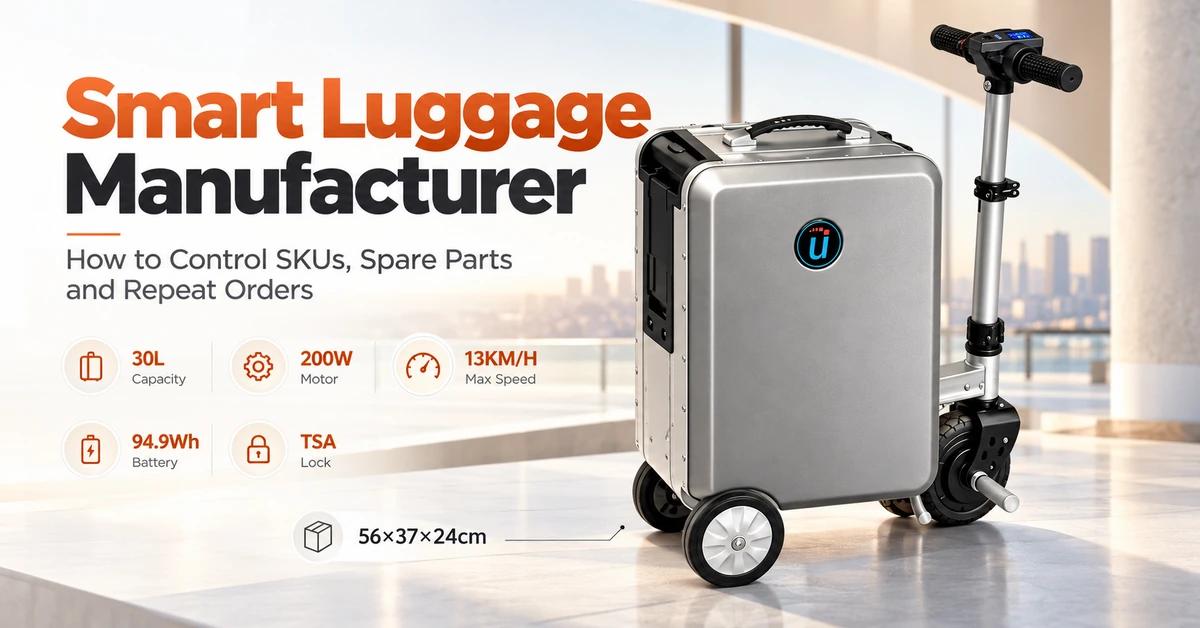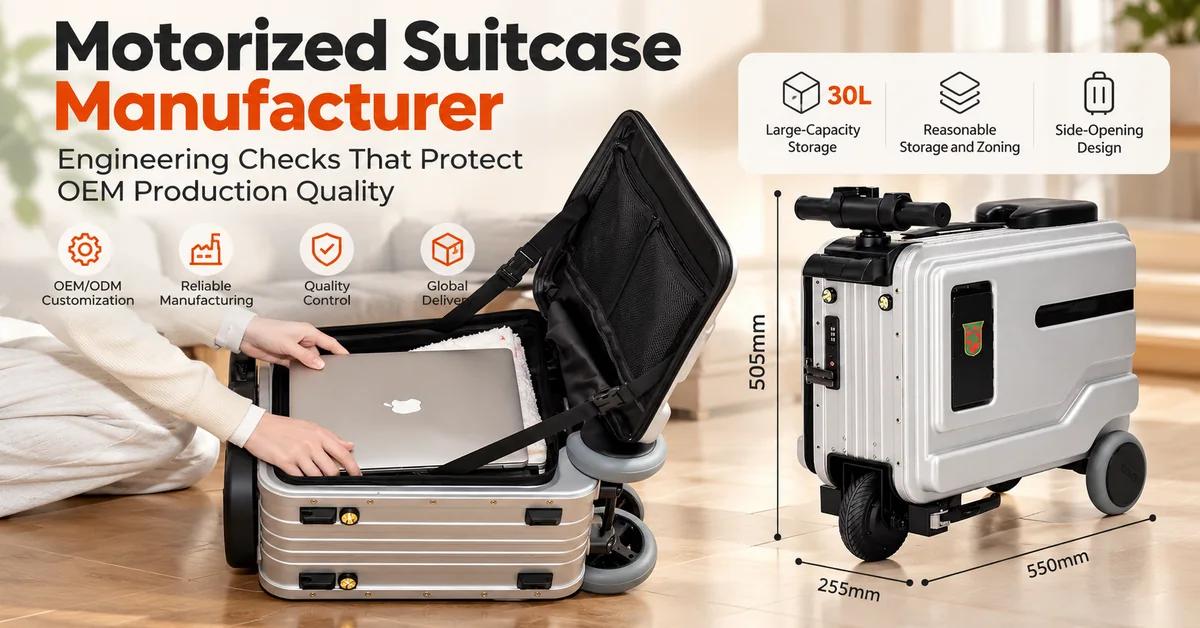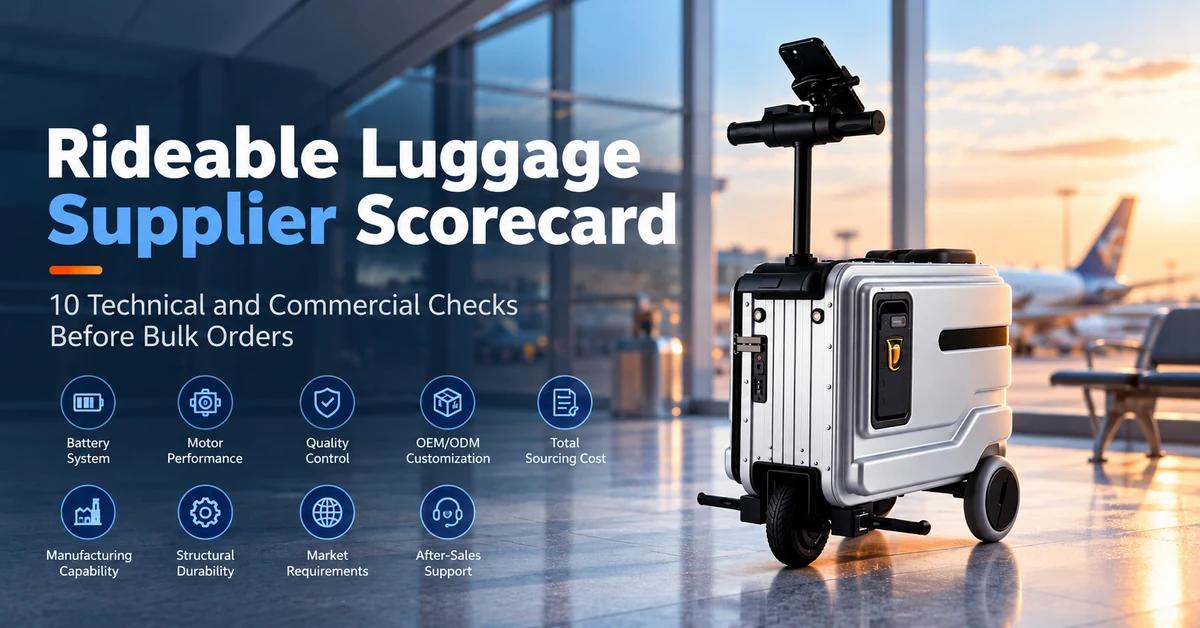
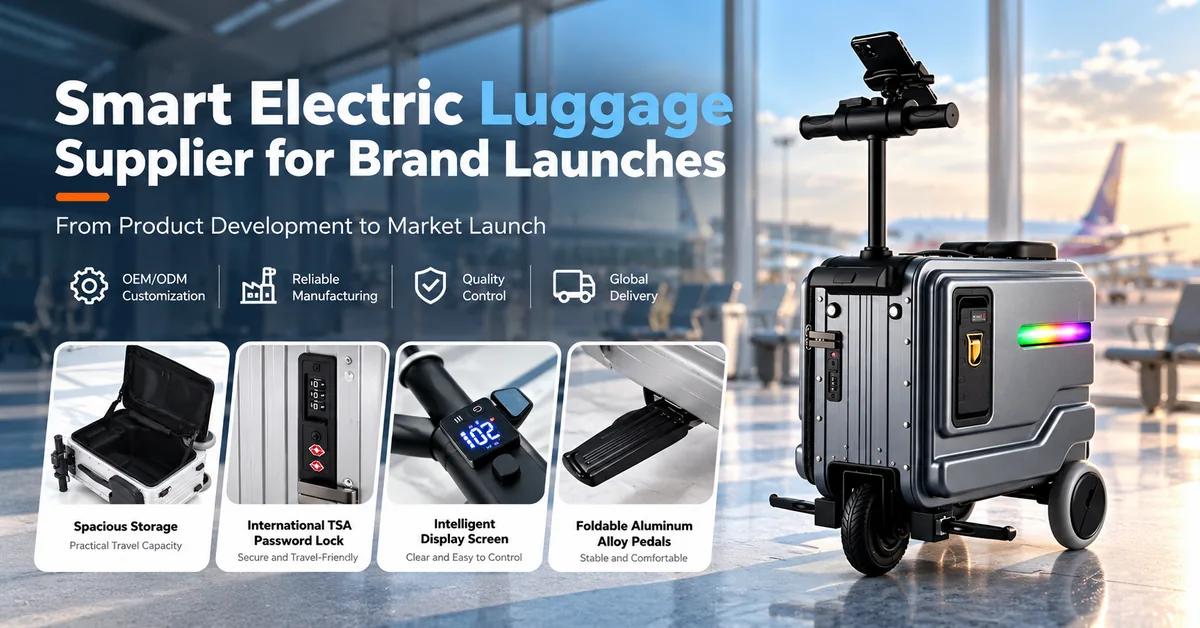
Launching a smart electric luggage brand requires more than sourcing a suitcase with an electric motor. Importers, travel brands, and wholesale distributors must coordinate product positioning, battery integration, structural design, manufacturing quality, customization requirements, and after-sales planning before entering the market.
A reliable smart electric luggage supplier should help buyers move from an initial product concept to approved samples, controlled production, and repeatable wholesale orders.
For B2B buyers, the most effective strategy is to select a suitable luggage platform, define the product specifications, evaluate OEM/ODM options, validate manufacturing quality, and establish clear commercial arrangements before placing a bulk order.
This guide explains the practical steps involved in developing and sourcing electric luggage for international markets, with particular attention to private-label brands, luggage importers, and product development teams.
OEASY supports international smart luggage projects through product development, precision manufacturing, OEM/ODM customization, quality coordination, and international delivery support.
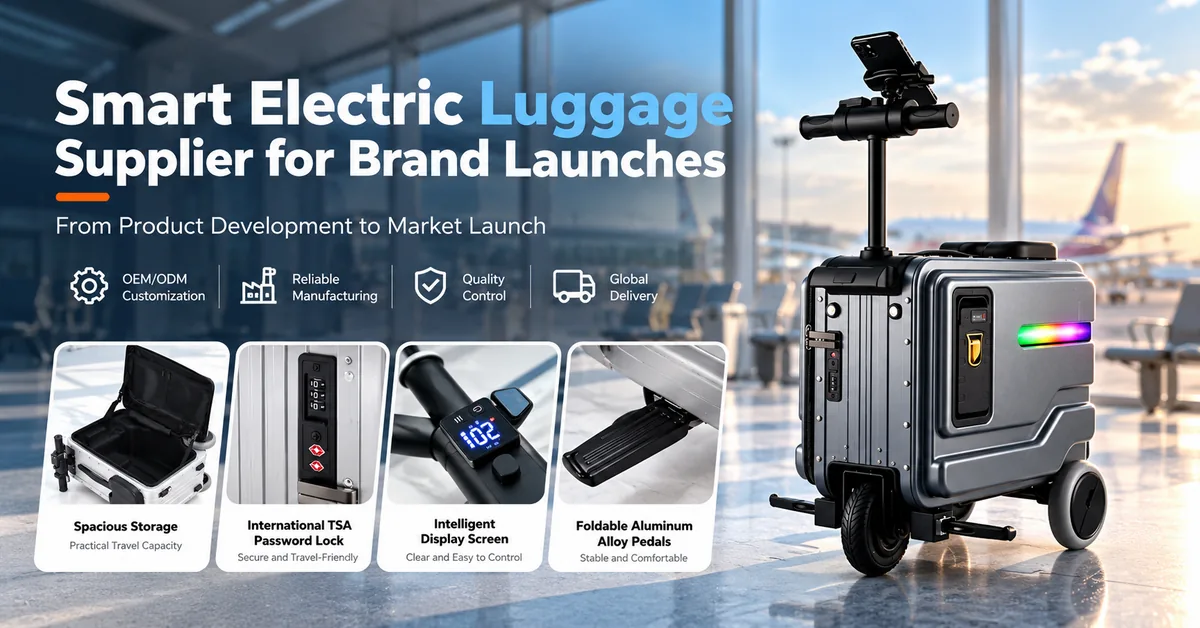
1. Why Does Supplier Selection Matter When Launching a Smart Electric Luggage Brand?
Smart electric luggage combines conventional luggage functions with powered mobility technology. Unlike ordinary suitcases, these products may integrate electric motors, rechargeable batteries, electronic controllers, luggage locks, folding structures, and additional user interfaces.
Each component introduces considerations affecting product cost, functionality, safety, durability, and long-term customer satisfaction.
A smart electric luggage supplier must therefore understand how mechanical, electrical, and luggage components work together.
Common Challenges Faced by International Buyers
Travel brands entering this product category frequently encounter several challenges.
Limited product differentiation: Similar-looking products make it difficult for retailers to establish a distinctive brand position.
Unclear technical specifications: Battery capacity, motor output, product weight, and load ratings may vary considerably between models.
Customization complexity: Changes to the housing, electrical system, or battery compartment can require additional engineering and testing.
Inconsistent production quality: A successful prototype does not automatically guarantee consistent mass production.
Transportation and market restrictions: Battery-powered luggage can face different requirements depending on its configuration, destination, and intended use.
After-sales uncertainty: Replacement batteries, mechanical components, and warranty procedures may affect product profitability.
These challenges explain why buyers should evaluate a supplier's development and manufacturing capabilities instead of focusing exclusively on product appearance or unit price.
Which Companies Need a Manufacturing-Oriented Supplier?
| Buyer Type | Main Objective | Recommended Cooperation |
|---|---|---|
| Travel luggage brands | Introduce an innovative product category | OEM or ODM manufacturing |
| Importers and distributors | Establish reliable wholesale supply | Existing product platform |
| Private-label retailers | Develop branded electric luggage | OEM customization |
| Premium travel brands | Differentiate through design and functionality | Premium platform or ODM |
| Product development teams | Transform concepts into manufacturable products | Engineering and ODM development |
| Multi-market distributors | Build a diversified product portfolio | Platform selection and configuration planning |
For brands planning repeat purchases, sourcing should be treated as a long-term product program rather than a single transaction.
2. How to Choose the Right Smart Electric Luggage Platform
One of the first purchasing decisions is determining which product platform matches the intended market.
Different customers prioritize different features.
Entry-level consumers may value practical functionality and competitive pricing, while premium customers may place greater emphasis on design, user experience, integrated controls, and material finishes.
OEASY currently offers four main smart electric luggage platforms.
ES1 Essential: Value-Focused Electric Luggage
The ES1 Essential Series is positioned around practical electric mobility and accessible market positioning.
It is particularly relevant to travel retailers, wholesalers, distributors, and private-label brands developing value-focused product ranges.
Buyers may evaluate ES1 when their priorities include essential functions, recognizable product benefits, and controlled product complexity.
ES2 Performance: Performance-Oriented Ride-On Luggage
The ES2 Performance Series focuses on electric ride-on mobility and practical travel functionality.
It is intended for frequent travelers, performance-oriented travel brands, and premium distribution programs.
The ES2 Pro configuration incorporates an electric drive system, removable battery, luggage security features, and user-oriented components.
Brands targeting performance-conscious customers may consider this platform when building a differentiated product range.
ES3 Executive: Premium Business Travel Positioning
The ES3 Executive Series emphasizes business-oriented styling, smart functions, and premium product presentation.
Potential target markets include executive travel brands, premium luggage retailers, and corporate travel product programs.
Buyers should evaluate material finishes, control interfaces, appearance, product weight, and the requirements of their intended users.
Specific ES3 model names and specifications should be confirmed before developing sales materials.
ES4 Versatile: Flexible Multi-Function Product Development
The ES4 Versatile Series is positioned as a flexible platform for different travel scenarios and product configurations.
It may be relevant to multi-market distributors, specialized travel brands, and businesses considering more customized product programs.
Configuration availability and technical feasibility should be evaluated according to individual project requirements.
Smart Electric Luggage Platform Comparison
| Platform | Positioning | Suitable Buyers | Main Development Priority |
|---|---|---|---|
| ES1 Essential | Value-focused | Wholesale distributors, private-label retailers | Practical features and cost positioning |
| ES2 Performance | Performance-oriented | Travel brands, premium distributors | Electric mobility and user functionality |
| ES3 Executive | Premium business | Executive travel brands, premium retail | Design, finish and integrated functions |
| ES4 Versatile | Multi-function | Multi-market brands, ODM buyers | Flexible configuration and differentiation |
Purchasing recommendation: Select a platform according to your target market, retail positioning, and required functions before discussing detailed product customization.
Explore the complete OEASY smart electric luggage collection for available product options.
3. What Technical Specifications Should Buyers Define Before Sampling?
A clear technical specification is essential for productive communication between brands and manufacturers.
Without one, suppliers may quote different configurations, making direct comparisons difficult.
Core Technical Specification Checklist
| Specification | What Buyers Should Confirm | Purchasing Importance |
|---|---|---|
| Motor system | Rated power, voltage, motor type | Performance and system integration |
| Battery | Voltage, Wh capacity, removability | Operation, servicing and transport review |
| Operating speed | Available speed modes and test conditions | Intended user experience |
| Rated load | Approved maximum operating load | Structural suitability |
| Product weight | Net weight of the selected configuration | Handling and mobility |
| Storage capacity | Usable luggage volume | Customer practicality |
| Dimensions | External measurements and relevant configurations | Transport and retail positioning |
| Materials | Housing and frame construction | Durability, weight and appearance |
| Wheel system | Wheel arrangement and intended surfaces | Mobility and stability |
| Control system | Operating interface, indicators and protective functions | Usability |
| Charging interface | Input/output configuration and accessories | Electrical compatibility |
| Product security | Lock design and access features | Travel functionality |
All specifications should refer to an identifiable model and approved configuration.
Understanding Motor Power and Battery Capacity
Motor wattage describes an electrical performance characteristic, but it does not independently determine speed, acceleration, climbing capability, or riding range.
Actual performance depends on the complete drive system, load, wheel arrangement, controller settings, and operating conditions.
Battery capacity is commonly expressed in watt-hours (Wh).
It provides a useful basis for comparing nominal stored energy, but actual operating duration depends on power consumption and usage conditions.
For example, OEASY's published ES2 Pro information includes a 250 W brushless motor and a removable 93.6 Wh battery.
These specifications are specific to the relevant product version and should be verified against the current technical datasheet.
Why Product Architecture Matters
Electric luggage requires careful coordination between several systems.
Mechanical Structure
The frame, wheel mounts, handle components, and any seating or footrest structures need to support their intended operating loads.
Electrical Integration
Motors, batteries, wiring, electronic controllers, and user interfaces must be integrated within the product's available space.
Luggage Functionality
Internal storage, locking systems, access panels, and charging interfaces must remain practical for the intended customer.
Serviceability
Battery access, spare-parts replacement, and maintenance procedures should be considered early in product development.
A good product design balances these factors rather than maximizing a single performance specification.
4. OEM vs ODM: Which Manufacturing Approach Fits Your Brand?
Private-label and custom product projects commonly use two different development approaches.
OEM Smart Electric Luggage Manufacturing
OEM manufacturing generally involves selecting an existing product platform and applying approved brand or configuration changes.
Depending on the product, these may include:
-
Brand logos and product labeling.
-
Shell colors and exterior finishes.
-
Customized packaging.
-
Selected accessories.
-
Approved battery or component configurations.
-
Other project-specific modifications.
OEM is particularly relevant to brands seeking to establish a differentiated product offering without developing an entirely new luggage architecture.
However, customization availability depends on the selected platform and approved engineering requirements.
ODM Smart Electric Luggage Development
ODM development is appropriate when the buyer requires more substantial design or engineering involvement.
Projects may involve:
-
New exterior styling.
-
Customized structural components.
-
Modified internal compartments.
-
Electronics integration.
-
Control interface development.
-
Prototype optimization.
-
New production tooling.
-
Engineering validation.
ODM allows businesses to explore a more distinctive product direction, but it may also introduce additional development costs, tooling requirements, and technical risks.
OEM vs ODM Comparison
| Factor | OEM Manufacturing | ODM Development |
|---|---|---|
| Starting point | Existing product platform | Product concept or modified platform |
| Customization scope | Approved branding and configuration | Potentially extensive design changes |
| Engineering requirements | Usually more limited | Project-dependent and potentially substantial |
| Tooling | May use existing tooling | New tooling may be required |
| Sampling | Configuration approval | Design and engineering validation |
| Best suited for | Private-label brands and distributors | Product developers and differentiated brands |
| Cost structure | Product plus agreed customization | Product plus development and possible tooling |
| Production schedule | Based on approved changes | Depends on project complexity and validation |
For businesses entering the smart luggage market for the first time, an existing platform with carefully chosen customization options may be a practical starting point.
Learn more about OEASY's OEM/ODM development workflow.
5. From Product Brief to Production: The Smart Luggage Development Workflow
A structured development process helps buyers control design decisions, technical risk, and manufacturing changes.
OEASY describes an eight-stage OEM/ODM workflow.
Stage 1: Product Concept
The buyer defines the target customer, retail channel, intended market, required functions, and commercial objectives.
A useful product brief should include the anticipated selling price, purchasing volume, preferred platform, and customization scope.
Stage 2: Industrial Design
The product's appearance, proportions, colors, ergonomic considerations, and user experience are reviewed.
Design choices should reflect both market positioning and practical manufacturing requirements.
Stage 3: Engineering Development
Engineering teams evaluate structural components, electrical integration, battery placement, assembly requirements, and manufacturability.
This stage helps identify potential conflicts between product design and production feasibility.
Stage 4: Prototype Development
A prototype allows buyers to review the physical product before approving significant production investment.
The evaluation should include appearance, assembly, functionality, ergonomics, and the agreed operating requirements.
Stage 5: Mold Manufacturing
When new components require production tooling, mold design and manufacturing follow the approved engineering specification.
Projects using existing product platforms may not require entirely new molds.
Stage 6: Testing and Validation
Product-specific validation is performed according to agreed requirements.
Testing may address electrical functions, batteries, structural loads, component assembly, and other relevant performance characteristics.
Stage 7: Mass Production
Once samples and specifications are approved, production can be organized according to the agreed configuration and quality plan.
Changes introduced after approval should follow a documented review process.
Stage 8: Global Delivery
Packaging, shipment documentation, and logistics arrangements are coordinated according to the order requirements.
Importers should confirm the relevant battery transportation requirements and destination-market obligations before shipment.
Key takeaway: Prototype approval, documented specifications, and clearly defined quality criteria create the foundation for repeatable production.
6. How Manufacturing Capabilities Affect Product Quality and Scalability
Manufacturing capabilities influence product consistency, customization feasibility, and the ability to maintain an approved design across production batches.
Smart luggage manufacturing may involve multiple processes and specialist components.
OEASY's stated capabilities include CNC precision machining, injection molding, metal fabrication, surface treatment, assembly, and engineering support.
CNC Precision Machining
CNC machining supports the manufacture of approved metal components where dimensional accuracy and repeatability are important.
Potential applications include structural connectors, brackets, and other functional parts.
Injection Molding
Injection molding supports the production of plastic enclosure components and selected structural parts.
For custom projects, mold design and component geometry must be coordinated with assembly requirements.
Metal Fabrication
Metal fabrication may support frames, brackets, and other load-related assemblies.
Material and process choices should correspond to the approved structural design.
Surface Treatment
Surface treatment influences appearance and finishing consistency.
For private-label brands, surface finish and color matching can be important parts of product presentation.
Mechanical and Electrical Assembly
Final assembly brings luggage, mechanical, and electrical systems together.
Controlled assembly procedures help reduce the risk of configuration errors and inconsistent product functionality.
Engineering Support
Engineering support helps evaluate manufacturing feasibility, component integration, and production changes.
For buyers developing a long-term product range, consistent engineering documentation is essential.
Explore OEASY's manufacturing capabilities for further information.
7. Quality Control: How to Protect Your Brand Before Market Launch
A successful product launch depends on reliable performance across the delivered order, not only the sample displayed during supplier negotiations.
Quality control should therefore begin before final assembly.
Important Production Inspection Stages
Incoming Quality Control (IQC): Reviews incoming materials and components against defined requirements.
In-Process Quality Control (IPQC): Checks relevant production activities and assembly processes.
Final Quality Control (FQC): Evaluates finished products against approved specifications.
Outgoing Quality Control (OQC): Supports pre-shipment verification and release procedures.
OEASY describes these quality stages as part of its manufacturing workflow.
Recommended Product Validation Areas
Depending on the project, buyers should discuss:
-
Battery and charging functions.
-
Motor and controller operation.
-
Structural load requirements.
-
Wheel and handle assembly.
-
Luggage locking and opening functions.
-
Relevant durability testing.
-
Surface appearance and workmanship.
-
Packaging and transportation preparation.
Tests should have defined methods and acceptance limits where applicable.
Do not assume a product has passed a specific international standard unless the relevant evidence is available for the exact model.
Why Market-Specific Documentation Matters
Electric luggage can involve electrical product requirements, lithium battery transportation obligations, and restrictions on use in certain locations.
Certification and documentation needs vary by destination and product configuration.
CE, FCC, RoHS, UN38.3, and battery-related documentation may be relevant to particular products or markets, but their availability and scope must be verified individually.
Airline carriage requirements should be reviewed separately. A removable battery does not guarantee that a motorized ride-on suitcase will be accepted as passenger baggage.
8. Production Capacity, Lead Times, and Repeat-Order Planning
A reliable smart electric luggage supplier should help buyers plan beyond the initial order.
Production timing depends on the selected product platform, customization complexity, component availability, tooling requirements, and validation schedule.
Factors Affecting Project Lead Time
| Factor | Potential Effect |
|---|---|
| Standard or customized model | Changes engineering and preparation requirements |
| New tooling | May add development and validation stages |
| Battery and electronics availability | Can affect component sourcing |
| Sample revisions | May extend approval |
| Quality validation | Requires scheduling before release |
| Packaging customization | May affect procurement and preparation |
| Order quantity | Influences production allocation |
| Destination market | Affects documentation and logistics |
OEASY describes integrated manufacturing resources and international order coordination, but buyers should obtain a project-specific capacity and delivery confirmation.
Planning for Repeat Orders
After a successful launch, stable repeat orders require controlled product specifications.
Buyers should establish:
-
Approved model and configuration identification.
-
Component substitution approval procedures.
-
Consistent packaging requirements.
-
Quality acceptance criteria.
-
Reorder forecasting arrangements.
-
Spare-parts and warranty planning.
These controls become increasingly important when distributing products through multiple retail channels.
9. Understanding Smart Electric Luggage Sourcing Costs
The manufacturing cost of smart electric luggage depends on its technical configuration, selected materials, development requirements, production quantity, and order terms.
A practical cost assessment should distinguish between recurring unit costs and one-time development investments.
Main Cost Components
| Cost Category | Typical Considerations |
|---|---|
| Mechanical components | Housing, frame, wheels, handles and fittings |
| Electrical system | Motor, controller, battery and charging components |
| Manufacturing | Machining, molding, fabrication and assembly |
| Customization | Branding, finishes, packaging and selected features |
| Development | Engineering, prototypes and possible tooling |
| Quality control | Inspection, testing and documentation |
| Logistics | Packing, freight, import charges and insurance |
| After-sales | Warranty arrangements and replacement parts |
For brands planning multiple orders, one-time development costs should be assessed over an appropriate expected production volume.
However, forecast volumes should not be treated as guaranteed future sales.
How to Avoid Misleading Wholesale Price Comparisons
Request quotations based on identical technical requirements and commercial assumptions.
A lower quote may exclude batteries, accessories, packaging, inspection, or transportation costs that another supplier includes.
Before comparing proposals, clarify the product configuration, Incoterms, MOQ, payment conditions, and quotation validity.
The goal is to understand total sourcing economics, not simply identify the lowest advertised unit price.
10. How to Prepare a Successful Private-Label Product Launch
Product development does not end when production is completed.
Brands also need accurate sales information, appropriate operating instructions, and a practical customer support plan.
Before Launch
Prepare approved product specifications, product photography, packaging artwork, and applicable documentation.
Ensure marketing claims correspond to the actual supplied product.
For battery-powered products, confirm destination-market requirements and the permitted use cases before publishing travel-related claims.
During Launch
Monitor customer questions, product returns, usability concerns, and early warranty issues.
Feedback should be organized by model and production batch where practical.
After Launch
Review sales performance, service costs, customer feedback, and potential product improvements.
Discuss any proposed modifications with the manufacturer before implementing them in subsequent orders.
A structured launch-and-feedback process can help brands develop more sustainable product lines instead of frequently replacing products without learning from market performance.
11. Why Consider OEASY as Your Smart Electric Luggage Supplier?
OEASY is a China-based smart electric luggage brand supported by Hangzhou UNIWISE International Co., Ltd. for international business coordination and Ningbo UNIWISE Precision Machinery Co., Ltd. for engineering and manufacturing.
The business connects product development, precision manufacturing, quality coordination, and international project support.
Four Product Platforms
OEASY offers ES1 Essential, ES2 Performance, ES3 Executive, and ES4 Versatile product directions, allowing buyers to begin with different market positions.
OEM/ODM Development
The company's development workflow covers product concepts, industrial design, engineering, prototyping, tooling, testing, production, and delivery.
Precision Manufacturing Support
CNC machining, injection molding, metal fabrication, surface treatment, and assembly capabilities support approved smart luggage projects.
Quality Coordination
Incoming, in-process, final, and outgoing inspection checkpoints are integrated into the stated quality process.
International B2B Project Support
Overseas buyers can discuss product specifications, branding requirements, expected order quantities, and delivery arrangements with a coordinated international project team.
For more information, visit About OEASY.
12. Request a Smart Electric Luggage OEM/ODM Project Review
Whether you are launching a private-label luggage range or developing a differentiated travel product, the next step is to establish a clear manufacturing brief.
Information to Include in Your Inquiry
To support a more accurate project discussion, provide:
-
Your company and target sales market.
-
Intended customers and retail positioning.
-
Preferred OEASY product platform.
-
Estimated initial order quantity.
-
Required motor, battery, and functional specifications.
-
Branding and packaging requirements.
-
Any special design or engineering needs.
-
Target product launch schedule.
-
Required quality or market documentation.
-
Expected after-sales and spare-parts support.
The OEASY team can review your requirements and discuss suitable product platforms, customization feasibility, and possible sampling arrangements.
Looking for a manufacturing partner for your next smart luggage product line?
Explore OEASY Smart Electric Luggage Products
Discuss OEM/ODM Development with OEASY
Request a Project-Specific Quotation
13. Frequently Asked Questions About Smart Electric Luggage Suppliers
1. What does a smart electric luggage supplier provide?
A smart electric luggage supplier may provide finished electric luggage, product selection support, wholesale sourcing, customization, and coordination with manufacturing resources. Manufacturing-oriented suppliers may also support engineering, prototyping, quality control, and production planning.
2. Can I launch a private-label electric luggage brand without developing a new product?
Yes. An existing product platform may support approved changes to branding, colors, packaging, and selected configurations. Buyers should confirm available customization options and obtain sample approval before placing a bulk order.
3. What is the difference between OEM and ODM smart luggage?
OEM generally involves customization based on an existing product platform. ODM involves more extensive product design or engineering development. The appropriate option depends on the brand's differentiation goals, technical requirements, budget, and launch schedule.
4. Which OEASY electric luggage series should I choose?
ES1 Essential targets value-focused travel products, ES2 Performance emphasizes ride-on functionality, ES3 Executive focuses on premium business positioning, and ES4 Versatile supports flexible product configurations. The final choice should reflect your market and approved specifications.
5. What is the MOQ for wholesale smart electric luggage?
MOQ depends on the selected model, production requirements, and customization scope. OEASY evaluates minimum order quantities by project rather than publishing one universal MOQ for every product.
6. Can smart electric luggage batteries be customized?
Battery configuration changes may be considered during approved development projects. Feasibility depends on electrical compatibility, mechanical design, safety requirements, testing, and transportation documentation. Battery changes should not be treated as purely cosmetic customization.
7. How long does it take to develop custom electric luggage?
Development time varies according to project complexity. Existing-platform customization may require fewer stages than a new ODM product involving structural engineering, tooling, prototypes, and testing. Buyers should request a project-specific schedule.
8. What quality control processes should manufacturers use?
Relevant processes include incoming component inspection, in-process checks, functional testing, structural validation, final inspection, and outgoing quality control. Specific procedures and acceptance criteria should correspond to the approved product and destination market.
9. Are all smart electric suitcases allowed on airplanes?
No. Airline policies vary, and some carriers restrict motorized ride-on luggage even when its battery is removable. Buyers should verify the relevant airline rules, product classification, and transportation requirements before advertising airline compatibility.
10. How can I request a smart electric luggage manufacturing quotation from OEASY?
Provide your target market, product direction, expected quantity, required specifications, branding needs, and delivery expectations through the OEASY contact page. The international project team can review your requirements and discuss suitable next steps.
Conclusion
Choosing the right smart electric luggage supplier is a strategic decision for travel brands, importers, and distributors planning to enter or expand within the electric luggage market.
A successful product launch requires more than innovative features. Buyers must coordinate product selection, engineering specifications, battery and structural design, OEM/ODM customization, manufacturing quality, market requirements, and long-term supply planning.
Working with a manufacturing-oriented partner can help businesses establish clearer product requirements, validate samples, and prepare for controlled production and repeat orders.
OEASY provides four smart electric luggage platforms supported by engineering development, precision manufacturing, OEM/ODM services, and international project coordination. These resources offer a starting point for brands developing their own electric luggage product programs.
Planning a private-label electric luggage launch or wholesale sourcing project? Contact OEASY to discuss your target market, preferred configuration, customization requirements, and a project-specific manufacturing quotation.