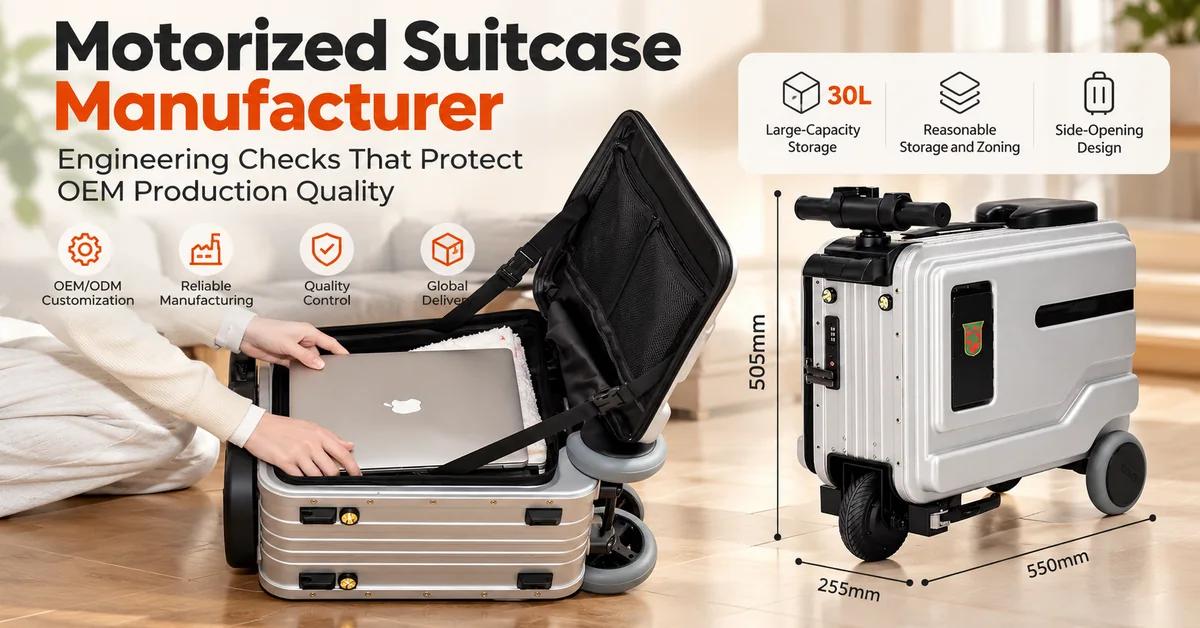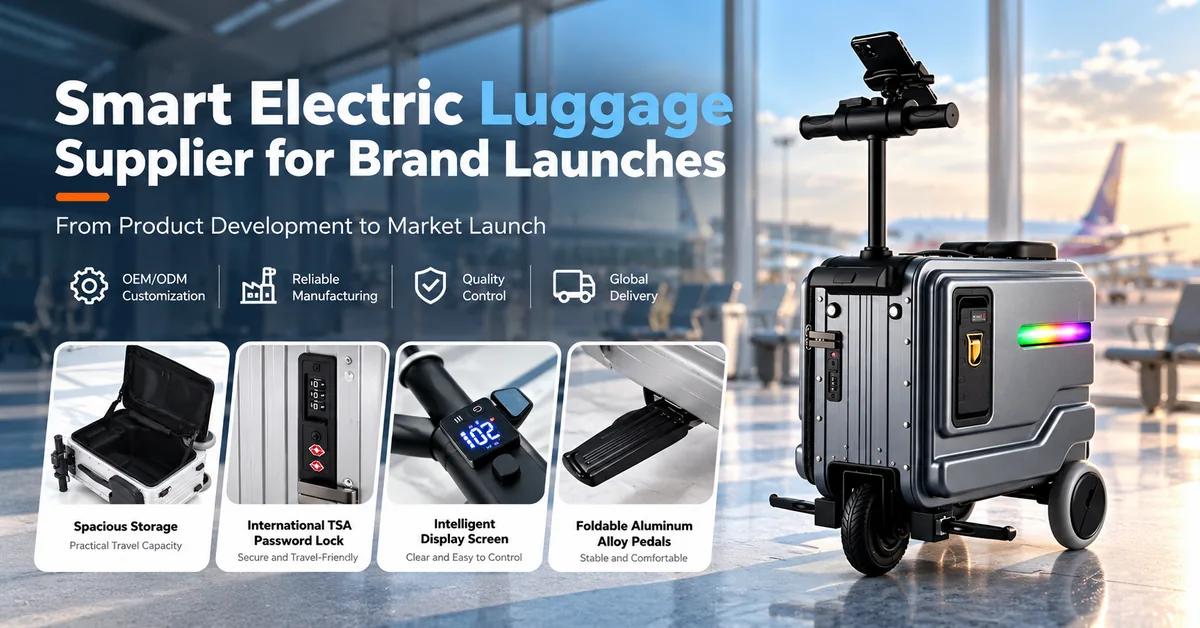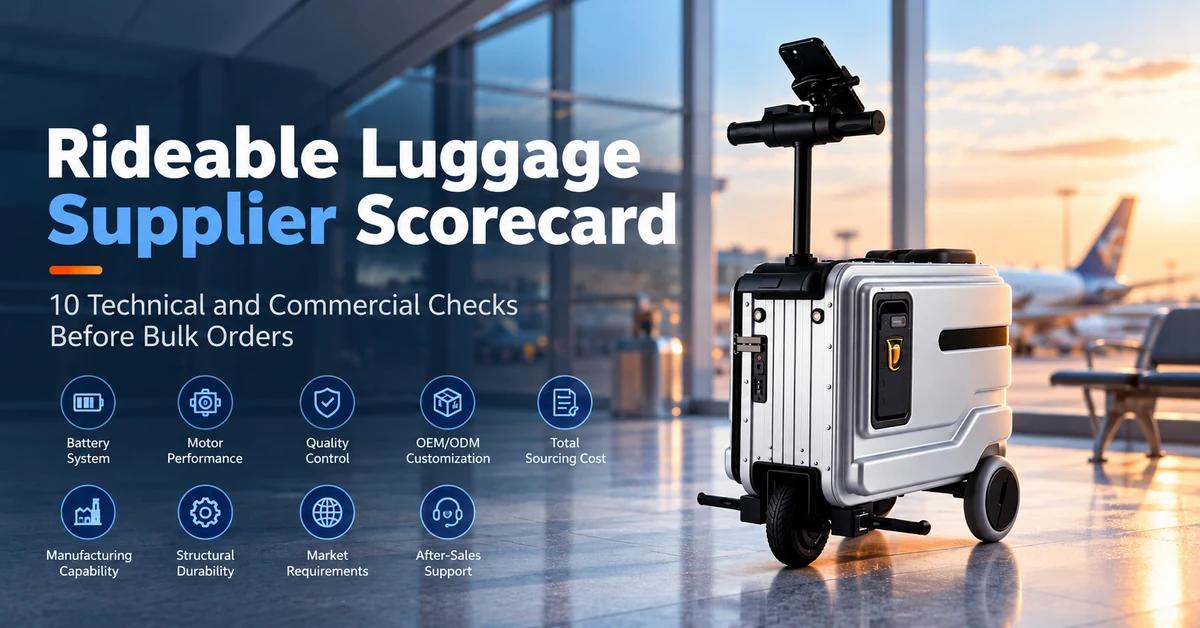
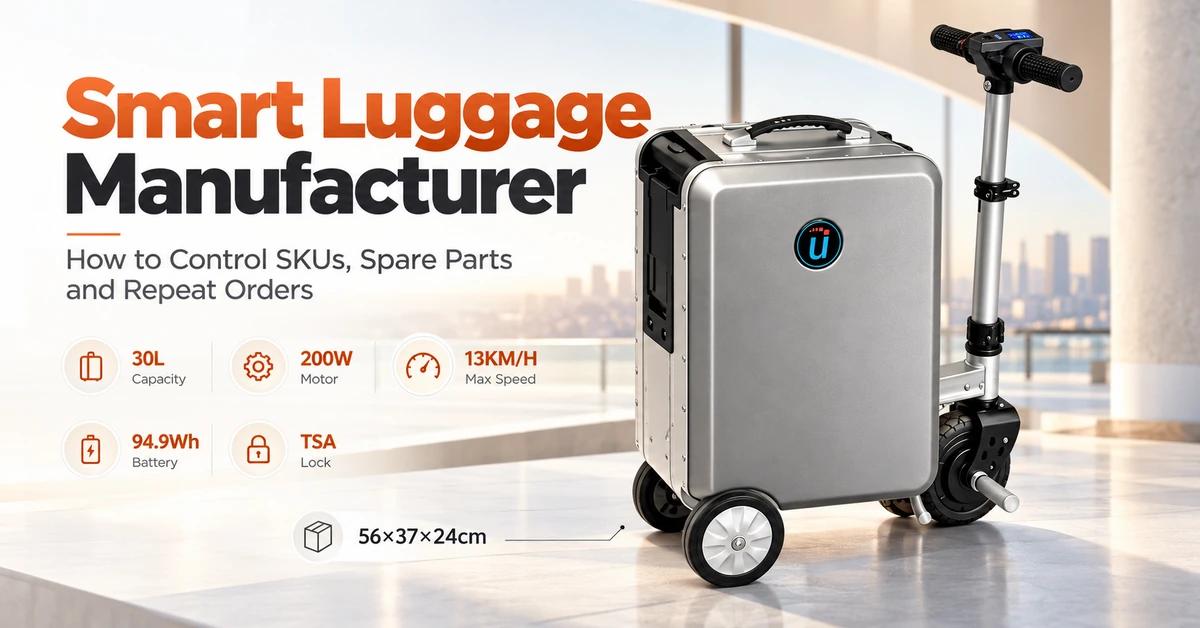
Choosing a smart luggage manufacturer is an important decision for travel brands, luggage importers, and wholesale distributors planning to sell several electric suitcase models. While product appearance and technical performance matter, long-term profitability also depends on how consistently a manufacturer manages configurations, components, quality standards, replacement parts, and repeat production.
For buyers managing multiple products, even a small specification change can create inventory complications, inconsistent customer experiences, or additional after-sales costs.
A reliable smart luggage manufacturer should support clear product platform selection, documented technical configurations, controlled manufacturing processes, and repeat-order consistency. Buyers should also establish practical arrangements for product revisions, quality inspection, and replacement components.
This guide explains how overseas B2B buyers can organize an electric luggage product portfolio without unnecessary SKU complexity, compare suitable manufacturing platforms, and prepare for sustainable wholesale sourcing.
OEASY supports international smart electric luggage projects through product development, precision manufacturing, OEM/ODM customization, and quality coordination.
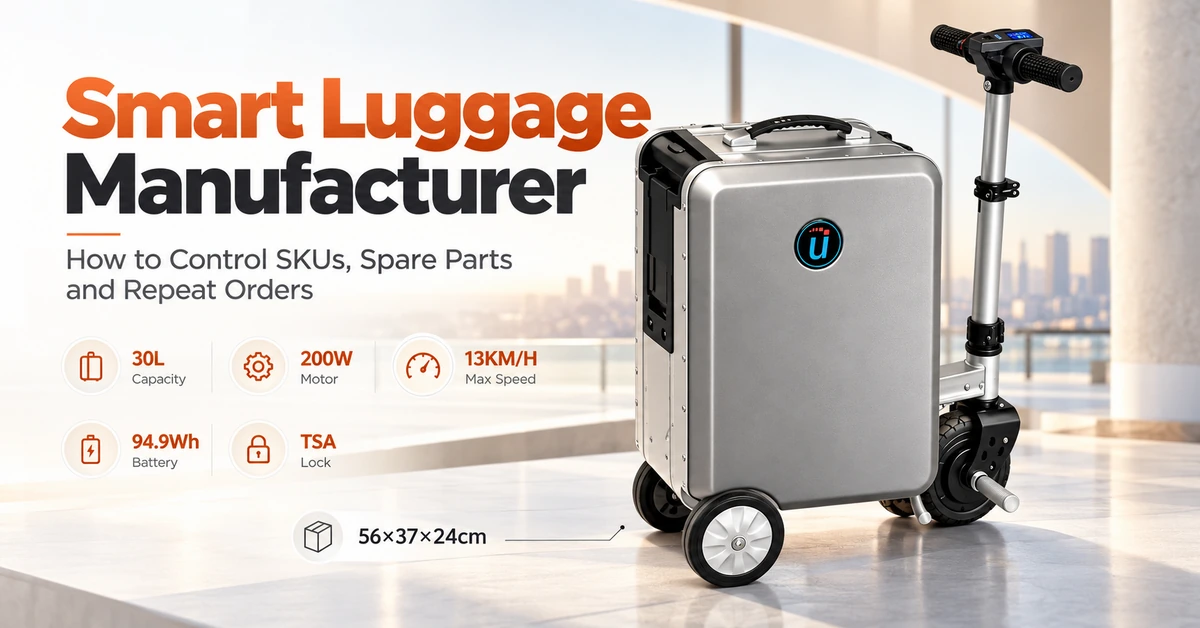
1. Why Multi-Model Smart Luggage Sourcing Requires a Different Strategy
Managing one electric suitcase product is different from managing a complete product portfolio.
A distributor may initially purchase one model but later introduce additional colors, premium versions, customized packaging, or products designed for different customers.
Each change can create a new stock keeping unit (SKU).
Common Challenges for Growing Luggage Brands
As product portfolios expand, buyers may encounter:
-
Too many configurations with overlapping functions.
-
Unclear differences between product versions.
-
Inconsistent technical specifications across orders.
-
Difficulty identifying compatible replacement parts.
-
Higher inventory management costs.
-
Delays caused by customized components.
-
Inconsistent packaging and product documentation.
-
Uncertainty about product changes between production batches.
These problems are particularly relevant to electric luggage because battery systems, motor assemblies, controllers, structural components, and charging accessories may vary between products.
Which Buyers Need a Structured Product Portfolio?
| Buyer Type | Main Challenge | Recommended Approach |
|---|---|---|
| Wholesale importers | Managing multiple product configurations | Standardize approved specifications |
| Private-label brands | Balancing differentiation and inventory | Limit unnecessary SKU variations |
| Travel retailers | Selecting products for different price positions | Build clear entry, performance, and premium ranges |
| Distributors | Maintaining repeat-order consistency | Establish configuration and quality records |
| Product development teams | Coordinating custom components | Control engineering revisions |
| Premium luggage brands | Managing appearance and technology options | Define approved materials and functions |
A practical product strategy starts with the intended customer rather than the number of available configurations.
2. How Should a Smart Luggage Manufacturer Help Plan a Product Portfolio?
The first step is dividing products according to their intended commercial roles.
An effective product range does not necessarily require many unrelated suitcase designs.
Instead, brands can evaluate existing product platforms and select the models that serve distinct customer requirements.
A Four-Level Product Portfolio Strategy
Entry-Level Products
Entry-level products focus on essential functionality, practical usability, and suitable market positioning.
These products may be relevant to price-conscious retail channels and distributors entering the electric luggage category.
Performance-Oriented Products
Performance-oriented products emphasize electric mobility functions, user controls, and suitable drive-system configurations.
They may appeal to frequent travelers and brands targeting performance-conscious customers.
Premium Business Products
Premium products emphasize industrial design, finishes, integrated functions, and the overall user experience.
This positioning may be appropriate for executive travel brands and higher-end retail channels.
Multi-Function or Customized Products
Flexible product platforms can support different market requirements and product development objectives.
They may be suitable for brands exploring differentiated configurations or specialized applications.
Why Platform-Based Sourcing Matters
Organizing products around defined platforms helps buyers understand which models serve different customers.
It also provides a framework for comparing customization options, technical requirements, procurement costs, and inventory planning.
However, products belonging to the same commercial platform should not automatically be assumed to share interchangeable electrical or mechanical components.
Component compatibility must be verified by the manufacturer.
3. Comparing OEASY's Four Smart Electric Luggage Platforms
OEASY provides four product platforms with different commercial positioning.
These platforms give overseas buyers a starting point for building smart electric luggage product lines.
OEASY Product Platform Comparison
| Product Platform | Market Positioning | Target Customers | Recommended B2B Application |
|---|---|---|---|
| ES1 Essential | Essential electric mobility | Value-focused travelers | Entry-level retail and wholesale |
| ES2 Performance | Performance-oriented mobility | Frequent travelers | Travel brands and premium distribution |
| ES3 Executive | Premium business travel | Executive users | Premium retail and private-label programs |
| ES4 Versatile | Flexible multi-function luggage | Multiple customer segments | Customized and multi-market programs |
The comparison describes the positioning of the four platforms. Actual product specifications, prices, and customization options should be confirmed for the selected configuration.
ES1 Essential: Building an Accessible Product Range
The ES1 platform focuses on essential smart mobility functions and practical product positioning.
It provides a starting point for distributors seeking electric luggage products for value-focused travel markets.
Buyers can discuss branding, colors, packaging, and approved configuration options based on the selected product.
ES2 Performance: Adding a Distinct Performance Tier
The ES2 platform emphasizes powered mobility and practical travel functionality.
The published ES2 Pro configuration includes a 250 W brushless motor, a removable 93.6 Wh battery, and integrated travel features.
These characteristics can help a brand distinguish its performance-oriented products from its entry-level range.
Review the ES2 Pro Performance Electric Ride-On Suitcase for further product information.
ES3 Executive: Developing a Premium Product Range
The ES3 Executive platform targets business travelers and premium luggage brands.
Its positioning emphasizes exterior design, integrated smart functions, and a professional travel experience.
Brands can assess it for premium retail and private-label applications.
Specific ES3 model names and technical specifications should be confirmed with current product documentation before procurement.
ES4 Versatile: Exploring Flexible Product Configurations
ES4 provides a multi-function product direction for brands considering different travel scenarios and market requirements.
Its flexible positioning may be useful for customized product development.
Any proposed modification should undergo technical and commercial review before approval.
Product planning recommendation: Choose platforms that serve clearly different customers rather than introducing multiple models that compete for the same market position.
Explore the complete OEASY smart electric luggage range.
4. How to Build a Clear Smart Luggage SKU Structure
A SKU identifies a specific product configuration used for inventory, sales, and order management.
For electric luggage, it should help distinguish meaningful differences in product specifications.
Four Elements of a Practical SKU Structure
A useful structure may include:
-
Product platform: ES1, ES2, ES3, or ES4.
-
Approved model version: The exact product revision.
-
Commercial configuration: Approved colors, branding, or packaging.
-
Sales-market variant: Market-specific accessories or documentation where applicable.
For example, an internal buyer code could distinguish an ES2 configuration for one market from an ES2 configuration approved for another.
Such codes are purchasing-management examples, not official OEASY product identifiers.
Avoid Unnecessary SKU Expansion
Not every packaging adjustment or marketing difference requires a separate technical product version.
Buyers should distinguish commercial differences from engineering changes.
A new shell color may require a commercial SKU, while a different battery or controller configuration may require additional technical documentation and validation.
The Importance of Version Control
Before each purchase order, the buyer and supplier should confirm the approved product version.
A configuration record should identify the critical components, packaging specifications, and accepted changes.
This helps prevent unintended substitutions between orders.
5. Which Technical Specifications Should Remain Consistent Across Orders?
Repeat-order quality depends on maintaining approved technical requirements.
A smart luggage manufacturer should be able to discuss which product characteristics require documented control.
Smart Luggage Technical Configuration Checklist
| Specification | Information to Record | Repeat-Order Importance |
|---|---|---|
| Product model | Exact model and revision | Prevents version confusion |
| Motor | Type, voltage and rated power | Supports drive-system consistency |
| Battery | Capacity, voltage and approved configuration | Supports electrical compatibility |
| Controller | Approved functions and configuration | Maintains operating behavior |
| Wheels | Dimensions, design and mounting | Supports mechanical consistency |
| Housing | Materials, dimensions and finish | Maintains structure and appearance |
| Load rating | Approved load and test conditions | Supports product suitability |
| Storage capacity | Approved usable volume | Maintains customer expectations |
| Charging system | Input and interface specifications | Supports accessory compatibility |
| Locking system | Approved lock configuration | Maintains luggage functionality |
| Packaging | Dimensions, inserts and labeling | Supports distribution consistency |
| Documentation | Required instructions and records | Supports market readiness |
Why Component Specifications Matter
An electric suitcase is an integrated system.
A change in battery dimensions may affect the enclosure. A controller revision may affect operating behavior. A different wheel assembly may change mechanical performance.
Consequently, component substitutions should be evaluated according to their possible effects on the finished product.
Buyers should agree on which substitutions require written approval, additional testing, or a new product revision.
6. Manufacturing Processes That Support Product Consistency
Smart electric luggage manufacturing involves multiple materials, components, and assembly operations.
Manufacturing consistency depends on coordinating these processes around the approved product design.
OEASY describes integrated engineering and manufacturing support for smart luggage projects.
CNC Precision Machining
CNC machining supports the production of approved metal parts requiring dimensional control.
These may include structural connectors, brackets, and other functional components.
Injection Molding
Injection molding supports plastic enclosure and luggage components.
Consistent tooling, materials, and process control are important for maintaining component fit and appearance.
Metal Fabrication
Metal fabrication supports frames and other structural assemblies according to the approved design.
Surface Treatment
Surface finishing contributes to the consistency of exterior appearance and approved colors.
This is particularly relevant to private-label brands managing several product variants.
Product Assembly
Assembly coordinates the mechanical structure, electronic systems, battery compartment, and luggage functions.
The approved assembly configuration should remain consistent across production batches unless changes are authorized.
Engineering Support
Engineering teams can evaluate design changes, component integration, and production requirements.
For multi-model sourcing programs, this coordination becomes especially important when several products are manufactured or updated concurrently.
Learn more about OEASY's manufacturing and engineering capabilities.
7. Why Spare-Parts Planning Matters for Smart Electric Luggage Brands
Replacement-parts availability can influence customer satisfaction and the total cost of supporting a product line.
Unlike conventional luggage, electric products may require servicing of both mechanical and electrical components.
Components Buyers Should Discuss
| Component Category | Potential Service Requirement | Purchasing Consideration |
|---|---|---|
| Battery assembly | Approved replacement | Compatibility and documentation |
| Wheels | Wear or mechanical damage | Correct model and mounting |
| Charging accessories | Lost or damaged accessories | Electrical specifications |
| Handles and controls | Mechanical or functional issues | Correct product revision |
| Electronic controller | Technical troubleshooting | Approved compatibility |
| Locks and fittings | Damage or replacement | Exact design |
| Exterior panels | Cosmetic or structural replacement | Availability and service feasibility |
Not all components are necessarily user-replaceable. Some repairs may require authorized technicians or replacement of larger approved assemblies.
A Practical Spare-Parts Planning Method
Buyers can estimate parts requirements using expected sales volumes, historical service experience, product lifecycles, and agreed warranty arrangements.
For a new model without service history, assumptions should be reviewed after initial sales rather than presented as established failure rates.
Avoid Assuming Parts Are Interchangeable
Two suitcase models may look similar while using different electrical connections, housing geometry, or structural components.
Before purchasing replacement parts, confirm compatibility using the exact product version.
OEASY's available spare-parts programs and commercial conditions should be discussed for the specific project rather than assumed to apply to every product.
8. Quality Control for Multiple Product Models and Repeat Orders
Quality control should verify that delivered products match the approved configuration, not merely that they appear functional.
OEASY describes incoming, in-process, final, and outgoing quality control checkpoints.
Incoming Quality Control
Incoming inspection helps verify that components and materials meet agreed requirements before production.
In-Process Quality Control
In-process checks can identify assembly and component-related issues before they become finished-product defects.
Final Quality Control
Final inspection evaluates finished products against defined appearance, functional, and configuration requirements.
Outgoing Quality Control
Pre-shipment verification supports order conformity and packaging checks.
A Repeat-Order Quality Checklist
For each order, buyers should consider reviewing:
-
Approved model and revision.
-
Critical component specifications.
-
Functional inspection requirements.
-
Appearance and workmanship criteria.
-
Packaging and labeling.
-
Selected inspection reports.
-
Approved engineering changes.
-
Shipment documentation.
Where required, battery, load, and drop testing should follow an agreed validation plan with defined acceptance criteria.
These controls are especially useful for international distributors managing several models or recurring purchase orders.
9. Certifications and Market Requirements Across Different SKUs
International buyers must evaluate applicable requirements for each product configuration and destination market.
A document associated with one model should not automatically be applied to a different product version.
Product and Battery Documentation
Depending on the market and configuration, buyers may need to review documentation relating to electrical equipment, lithium batteries, product labeling, and transport requirements.
Requirements associated with CE, FCC, RoHS, or UN38.3 may be relevant to specific projects.
The availability and applicability of documentation must be confirmed by model.
Passenger Airline Restrictions
Passenger baggage acceptance is separate from commercial cargo transportation.
The International Air Transport Association (IATA) publishes lithium battery baggage guidance, while individual airlines apply their own carriage policies.
For example, British Airways publishes restrictions on electric-powered ride-on baggage.
Therefore, removable batteries or battery capacity below 100 Wh do not guarantee airline acceptance.
Why Documentation Control Matters
Brands distributing several models should maintain a document register identifying which files apply to each configuration.
This reduces the risk of using outdated specifications or presenting inappropriate conformity claims.
10. How OEM and ODM Manufacturing Affect Product Portfolio Complexity
OEM and ODM services can help brands differentiate products, but customization must be managed carefully.
OEM: Managing Branded Variants
OEM projects generally begin with an existing platform.
Depending on the approved options, brands may customize:
-
Product colors.
-
Logos and labeling.
-
Packaging.
-
Selected accessories.
-
Certain product configurations.
OEM can be appropriate for brands seeking distinct commercial offerings without extensive redesign.
ODM: Developing New Product Features
ODM projects may involve industrial design, structural modifications, electronic integration, component housings, and new tooling.
More substantial changes can create additional documentation, testing, and spare-parts requirements.
OEASY's Development Workflow
OEASY describes an eight-stage development process:
-
Product Concept
-
Industrial Design
-
Engineering Development
-
Prototype
-
Mold Manufacturing
-
Testing
-
Mass Production
-
Global Delivery
The actual project scope depends on whether buyers are selecting existing configurations or developing substantially new products.
Explore the OEASY OEM/ODM development process.
11. How to Control Costs When Sourcing Several Smart Luggage Models
The purchasing cost of smart luggage extends beyond the initial unit quotation.
Brands managing multiple SKUs should evaluate inventory complexity, customization costs, logistics, spare-parts requirements, and long-term product support.
Main Cost Factors
| Cost Factor | Potential Impact | Management Strategy |
|---|---|---|
| Number of models | More inventory and purchasing complexity | Define distinct product roles |
| Product customization | Additional design or setup costs | Prioritize valuable differentiation |
| Component variations | More parts to manage | Verify compatibility and necessity |
| Packaging variations | Additional material and inventory needs | Standardize where appropriate |
| New tooling | Development investment | Review projected commercial value |
| Quality validation | Testing and inspection costs | Define requirements early |
| Replacement parts | Service inventory costs | Plan by actual product configuration |
| Logistics | Freight and import costs | Compare consistent delivery terms |
Evaluate Total Program Cost
The total cost of a multi-model product program includes product purchasing, development, logistics, inventory holding, inspection, and after-sales obligations.
Buyers should consider these expenses together rather than evaluating each product solely by its factory quotation.
MOQ and Lead-Time Planning
MOQ and production lead times can vary according to component availability, customization complexity, order quantity, and production arrangements.
For mixed-model orders, ask whether individual quantities and shipment schedules can be coordinated.
Do not assume that all configurations share the same MOQ or production timeline.
12. Why Consider OEASY for a Long-Term Smart Luggage Product Program?
OEASY is a China-based smart electric luggage brand supported by Hangzhou UNIWISE International Co., Ltd. for international business coordination and Ningbo UNIWISE Precision Machinery Co., Ltd. for engineering and manufacturing.
The company's product offering covers four smart electric luggage platform directions: ES1 Essential, ES2 Performance, ES3 Executive, and ES4 Versatile.
Its stated capabilities include precision manufacturing, engineering development, component integration, OEM/ODM customization, and quality coordination.
Product Platform Selection
The four product platforms provide different starting points for value-focused, performance-oriented, premium, and flexible product programs.
Engineering and Manufacturing Support
Coordinated machining, molding, metal fabrication, assembly, and engineering resources support approved product requirements.
OEM/ODM Development
Existing-platform customization and more substantial product development can be discussed according to project needs.
International Coordination
The international business team works with overseas buyers on product requirements, sampling, manufacturing arrangements, and delivery coordination.
For brands planning multiple products or repeat orders, these capabilities provide a basis for discussing a structured sourcing relationship.
Learn more about OEASY's company and manufacturing background.
Request a Multi-Model Smart Luggage Sourcing Review
If you are developing a new product portfolio or expanding an existing wholesale range, begin with a clear purchasing brief.
Provide your target market, preferred product platforms, expected order quantities, customization needs, required documentation, and anticipated reorder schedule.
For multiple models, identify which configurations require distinct technical specifications, spare parts, or packaging.
Looking for a smart luggage manufacturer for your next wholesale product program?
Explore OEASY Smart Electric Luggage Products
Discuss OEM/ODM Manufacturing Options
Request a Project-Specific Quotation
13. Frequently Asked Questions About Smart Luggage Manufacturing
1. What does a smart luggage manufacturer provide?
A smart luggage manufacturer may support product engineering, component production, assembly, quality inspection, and customization. For electric ride-on luggage, this can include mechanical structures, motors, battery compartments, electronic controls, and related integration.
2. How can I select the right smart luggage models for wholesale distribution?
Start with your target customers, sales channels, and price positioning. Choose products with distinct commercial purposes rather than purchasing several models with nearly identical features.
3. What is the advantage of using multiple product platforms?
Different platforms can help a brand serve value-focused, performance-oriented, premium, and specialized markets. Platform-based planning may also simplify product positioning and sourcing discussions, although component compatibility must still be verified.
4. Can smart electric luggage be customized with my own brand?
Yes. OEM projects may support approved branding, colors, packaging, accessories, and selected configurations. The available customization scope depends on the product platform and project requirements.
5. Can batteries and controllers be shared between different suitcase models?
Not automatically. Electrical compatibility, physical dimensions, connections, firmware or control requirements, and product validation must be reviewed before components are treated as interchangeable.
6. How should distributors manage replacement parts?
Maintain records identifying the exact product model and revision associated with each approved replacement component. Discuss parts availability, warranty arrangements, and repair procedures with the supplier before placing bulk orders.
7. What quality controls are important for repeat orders?
Important controls include approved specifications, incoming component checks, assembly inspections, functional testing, finished-product verification, and documented engineering changes.
8. What affects the MOQ for private-label smart luggage?
MOQ depends on the selected platform, customization requirements, materials, component sourcing, and production arrangements. Buyers should request project-specific terms rather than assuming a universal minimum quantity.
9. Are all smart electric luggage models permitted on passenger flights?
No. Some airlines restrict or prohibit motorized ride-on suitcases, even with removable batteries. Buyers should review the current airline policy and product-specific requirements before making transportation claims.
10. How can I request a multi-model smart luggage quotation from OEASY?
Share the target market, preferred product platforms, quantity by configuration, branding requirements, technical specifications, documentation needs, and expected purchasing schedule through the OEASY contact page.
Conclusion
Choosing a reliable smart luggage manufacturer is essential for brands seeking to build a sustainable electric luggage product portfolio.
When managing multiple models, purchasing success depends not only on product features but also on clear platform positioning, controlled technical specifications, coordinated manufacturing, quality consistency, replacement-parts planning, and repeat-order management.
A structured SKU strategy can help importers and distributors avoid unnecessary product variations while maintaining a product range suited to different customer segments.
OEASY offers four smart electric luggage platforms supported by engineering development, precision manufacturing, OEM/ODM customization, and international project coordination.
Whether your business is selecting its first electric luggage model or expanding an established wholesale portfolio, a clearly defined product configuration and sourcing plan can support more consistent procurement decisions.
Planning a multi-model smart luggage product line? Contact OEASY to discuss suitable platforms, customization requirements, production planning, and a project-specific quotation.