Finding a reliable rideable luggage supplier requires more than choosing a suitcase with an attractive design, powerful motor, or competitive wholesale price. For overseas importers, luggage distributors, and private-label brands, successful sourcing depends on consistent product quality, battery documentation, engineering support, customization flexibility, and dependable order fulfillment.
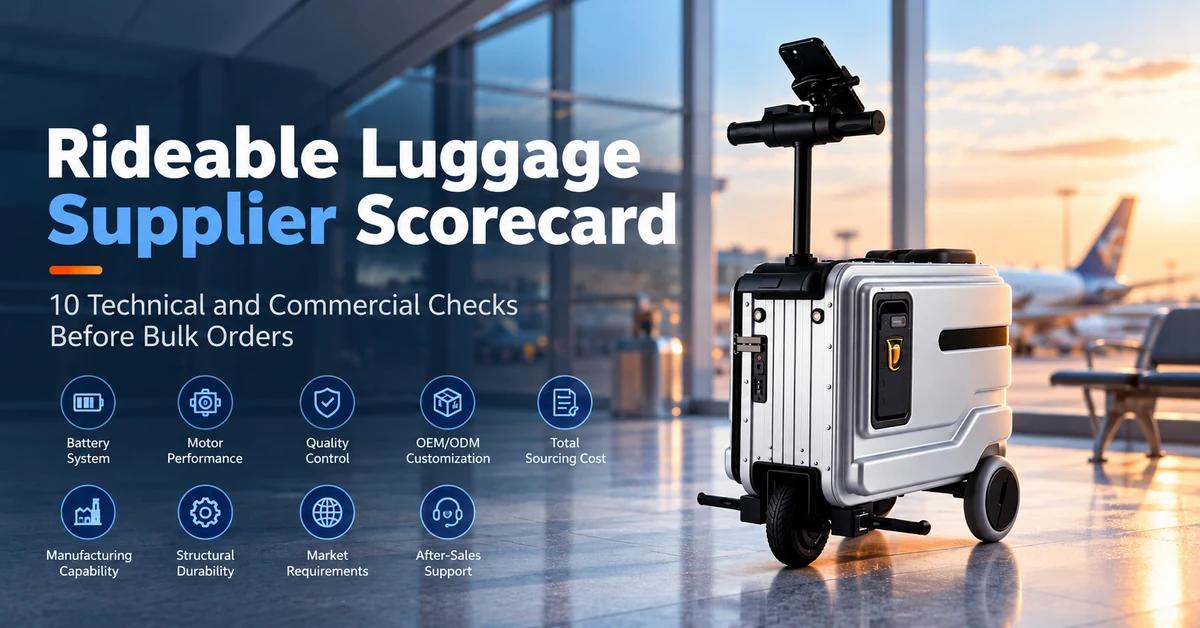
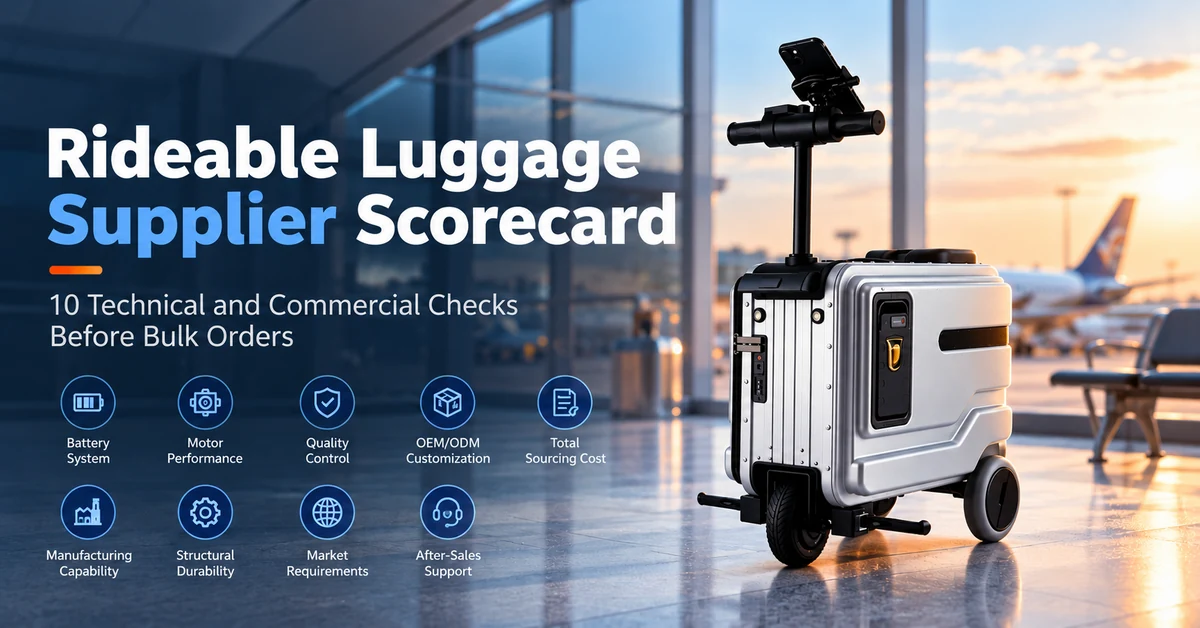
The most effective sourcing approach is to evaluate a supplier across 10 areas: product-market fit, battery systems, motor performance, structural durability, quality control, manufacturing capabilities, OEM/ODM readiness, market compliance, total sourcing cost, and after-sales support.
A supplier that can demonstrate these capabilities and provide verifiable product documentation is better positioned to support a repeatable wholesale program.
This guide introduces a practical purchasing scorecard and explains how to evaluate electric ride-on luggage before investing in samples, branding, tooling, or bulk inventory.
For brands exploring manufacturing partnerships, OEASY provides smart electric luggage platforms supported by engineering development, precision manufacturing, quality coordination, and OEM/ODM project services.
1. What Should B2B Buyers Expect From a Rideable Luggage Supplier?
A professional rideable luggage supplier should provide more than finished products. Because motorized luggage combines traditional suitcase components with electrical and mechanical systems, buyers need evidence that the supplier understands both luggage manufacturing and powered mobility integration.
A qualified sourcing partner should be able to discuss:
-
Product selection: Suitcase configurations suited to different target customers and retail price positions.
-
Technical specifications: Motor power, battery capacity, operating speed, dimensions, storage capacity, and rated load.
-
Manufacturing processes: Structural fabrication, injection molding, machining, electronics integration, and assembly.
-
Quality assurance: Inspection stages, functional checks, and agreed product validation procedures.
-
OEM/ODM customization: Branding, colors, packaging, selected component configurations, and product development.
-
Commercial reliability: Project-specific MOQ, sampling requirements, production scheduling, shipping documentation, and after-sales arrangements.
Which Buyers Benefit Most From Direct Supplier Cooperation?
|
Buyer Type |
Main Purchasing Priority |
Recommended Sourcing Strategy |
|---|---|---|
|
Luggage importers |
Consistency and landed cost |
Evaluate standard configurations and repeat-order capability |
|
Wholesale distributors |
Product positioning and resale potential |
Compare entry-level and performance-oriented platforms |
|
Private-label brands |
Brand differentiation |
Request color, logo, packaging, and configuration options |
|
Premium travel brands |
Design and user experience |
Evaluate executive-oriented luggage platforms |
|
Product development companies |
Engineering and customization |
Discuss ODM development and prototype requirements |
|
Travel retailers |
Retail presentation and product support |
Review demonstration samples, packaging, and documentation |
Rideable luggage is not automatically appropriate for every travel market. Buyers whose business depends on guaranteed airline carriage, unrestricted airport riding, or all-terrain operation must verify those requirements before selecting a product.
2. The 10-Point Rideable Luggage Supplier Evaluation Scorecard
A structured supplier evaluation helps purchasing teams compare technical capabilities and commercial risks without relying on marketing claims.
The following 100-point scorecard is a practical procurement framework, not an official certification or an assessment that any particular supplier has already passed.
|
Evaluation Criteria |
Weight |
Evidence to Request |
|---|---|---|
|
1. Product-market compatibility |
10 |
Model portfolio, target-market positioning |
|
2. Battery system and documentation |
15 |
Battery specifications, relevant test records |
|
3. Motor and control performance |
10 |
Motor data, operating modes, functional demonstrations |
|
4. Structural durability and ergonomics |
10 |
Materials, load ratings, approved test plans |
|
5. Quality control and validation |
15 |
Inspection procedures, test records, acceptance criteria |
|
6. Manufacturing and engineering capabilities |
10 |
Process descriptions, factory evidence, engineering support |
|
7. OEM/ODM customization readiness |
10 |
Customization scope, samples, tooling arrangements |
|
8. Destination-market and transport requirements |
10 |
Applicable documents, market-specific review |
|
9. Total sourcing cost and order planning |
5 |
Detailed quotation, MOQ, production schedule |
|
10. After-sales and spare-parts support |
5 |
Warranty terms, replacement-parts arrangements |
|
Total |
100 |
Documented supplier evaluation |
A high score indicates better alignment with the buyer's defined requirements. However, missing critical safety documentation, unacceptable product performance, or unresolved market restrictions should not be overlooked simply because a supplier achieves a high total.
Check 1: Does the Supplier Offer Products That Match Your Market?
A wholesale electric luggage supplier should understand the difference between entry-level distribution, premium retail, business travel, and customized mobility applications.
Selecting the wrong product platform can create pricing problems, unnecessary technical complexity, or weak market differentiation.
Before evaluating individual models, define the intended retail channel, target customer, expected price position, and product features that buyers actually value.
OEASY organizes its smart electric luggage offering into four platforms, allowing importers to compare different market positions before requesting a specific configuration.
Check 2: Can the Supplier Explain Its Battery System?
Battery design deserves particular attention because it affects product usability, servicing, documentation, and transportation arrangements.
Buyers should request the battery's rated voltage, capacity in watt-hours (Wh), removability, charging specifications, and applicable protection information.
A removable battery can make servicing and certain transportation arrangements more practical, but removability alone does not establish compliance with a destination market's requirements.
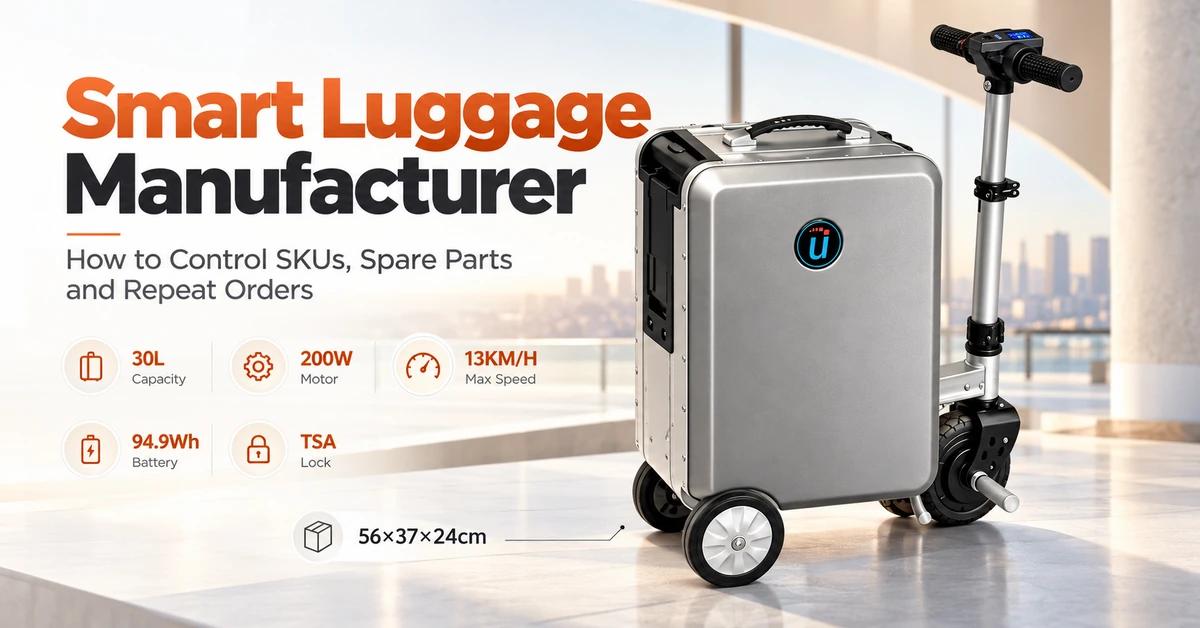
For example, OEASY's ES2 Pro has a published removable 93.6 Wh battery. That specification is useful for product comparison, but buyers must still verify the exact supplied battery configuration and relevant documents.
Check 3: Are Motor Performance and Operating Controls Suitable?
Motor wattage provides useful technical information, but it is not a complete measure of riding performance.
A professional supplier should help buyers understand the relationship between motor output, vehicle weight, rated load, wheel configuration, speed control, and intended operating surfaces.
Ask for functional demonstrations under defined conditions rather than relying only on a stated maximum speed.
Evaluate acceleration behavior, turning, stopping, control accessibility, and the transition between conventional luggage use and powered operation.
Check 4: Are the Frame, Wheels, and Housing Appropriate?
Unlike conventional luggage, a ride-on suitcase must accommodate additional loads from the rider, drive system, and supporting structures.
Important components include the frame, wheel mounts, handle connections, housing, footrests, and seating structure where fitted.
Material selection should be reviewed in relation to the actual design. Aluminum alloy and polycarbonate (PC), for example, can serve different structural and enclosure functions.
Request approved load ratings and appropriate validation evidence rather than assuming a particular material guarantees durability.
Check 5: Does Quality Control Continue Through Production?
A reliable rideable luggage supplier should maintain documented quality checkpoints throughout manufacturing, not inspect products only after assembly.
OEASY describes incoming material inspection, component inspection, assembly inspection, functional testing, battery testing, load testing, final inspection, and pre-shipment inspection. Drop testing is also included when required by an approved validation plan.
The company identifies IQC, IPQC, FQC, and OQC stages within its quality workflow.
For buyers, the essential question is how these checkpoints translate into measurable acceptance criteria, traceable records, and corrective actions when defects are found.
Learn more about OEASY's manufacturing and quality capabilities.
Check 6: Can the Supplier Support Engineering and Repeatable Manufacturing?
Rideable luggage integrates mechanical components, an electric drive system, a battery compartment, user controls, and storage space.
Suppliers with engineering and manufacturing coordination can review how these systems interact before production.
OEASY's stated capabilities include CNC precision machining, injection molding, metal fabrication, surface treatment, product assembly, and engineering support. These processes support the manufacture and integration of approved components.
Buyers should verify which processes are performed directly, how external resources are managed, and how changes to the approved specification are controlled.
Check 7: Is OEM/ODM Customization Clearly Defined?
Private-label buyers should distinguish between modifications to an existing platform and development of a substantially new product.
OEM projects may include approved adjustments to colors, logos, packaging, accessories, or selected components.
ODM projects may involve industrial design, structural engineering, electronic integration, prototyping, and tooling.
Before making a development commitment, confirm which specifications can change, who approves the prototype, who owns any new tooling, and how design revisions affect cost and schedule.
Check 8: Has Destination-Market and Transport Compatibility Been Reviewed?
This check is especially important for motorized travel products.
A removable battery or a battery capacity below 100 Wh does not automatically mean that an electric ride-on suitcase is accepted by every airline.
Passenger baggage rules, transport requirements for commercial shipments, and permission to ride in airports or other facilities are separate issues.
Some airlines restrict motorized ride-on baggage irrespective of battery removability. Buyers should review current IATA guidance, individual airline policies, destination-market requirements, and applicable transport documentation.
Ask suppliers to identify available testing and certification documents by exact product model. CE, FCC, RoHS, and UN38.3 should never be treated as universally applicable or automatically obtained across an entire product range.
Check 9: Is the Wholesale Quotation Commercially Complete?
The lowest unit quotation does not necessarily produce the lowest total procurement cost.
Request a quotation that distinguishes product configuration, optional features, branding, packaging, tooling, testing, and delivery terms.
MOQ and production schedules may change according to customization requirements and material availability.
Compare suppliers using the same product specifications, order quantities, delivery terms, and acceptance requirements.
Check 10: What Happens After the Products Reach Your Market?
After-sales arrangements should be discussed before placing a bulk order.
Buyers should clarify warranty coverage, spare battery availability, replacement wheels, charging accessories, repair procedures, and responsibility for defective units.
A clear agreement on spare parts and warranty handling can reduce disruptions for importers and private-label brands serving multiple sales channels.
3. Comparing OEASY's Four Rideable Luggage Platforms
OEASY's current product portfolio provides four primary smart electric luggage platforms with distinct market positioning.
The following comparison helps sourcing teams select an appropriate starting point before confirming specific model configurations.
|
Platform |
Primary Positioning |
Suitable B2B Buyers |
Sourcing Considerations |
|---|---|---|---|
|
Accessible, value-focused electric luggage |
Distributors, retailers, private-label brands |
Essential functions, cost positioning, practical mobility |
|
|
Performance-oriented ride-on luggage |
Travel brands, premium distributors |
Drive performance, battery configuration, user comfort |
|
|
Premium business-oriented smart luggage |
Executive travel brands, premium retail |
Design, finishes, integrated controls, brand positioning |
|
|
Flexible multi-function platform |
Multi-market brands, customization projects |
Product configuration, adaptability, development scope |
These are platform-level positioning differences, not confirmed price quotations or universal specifications.
Published Technical Specifications: ES1 Pro vs ES2 Pro
For buyers seeking specific examples, OEASY has published the following information about the ES1 Pro and ES2 Pro.
|
Specification |
ES1 Pro |
ES2 Pro |
|---|---|---|
|
Product direction |
Essential rideable luggage |
Performance rideable luggage |
|
Storage capacity |
36 L |
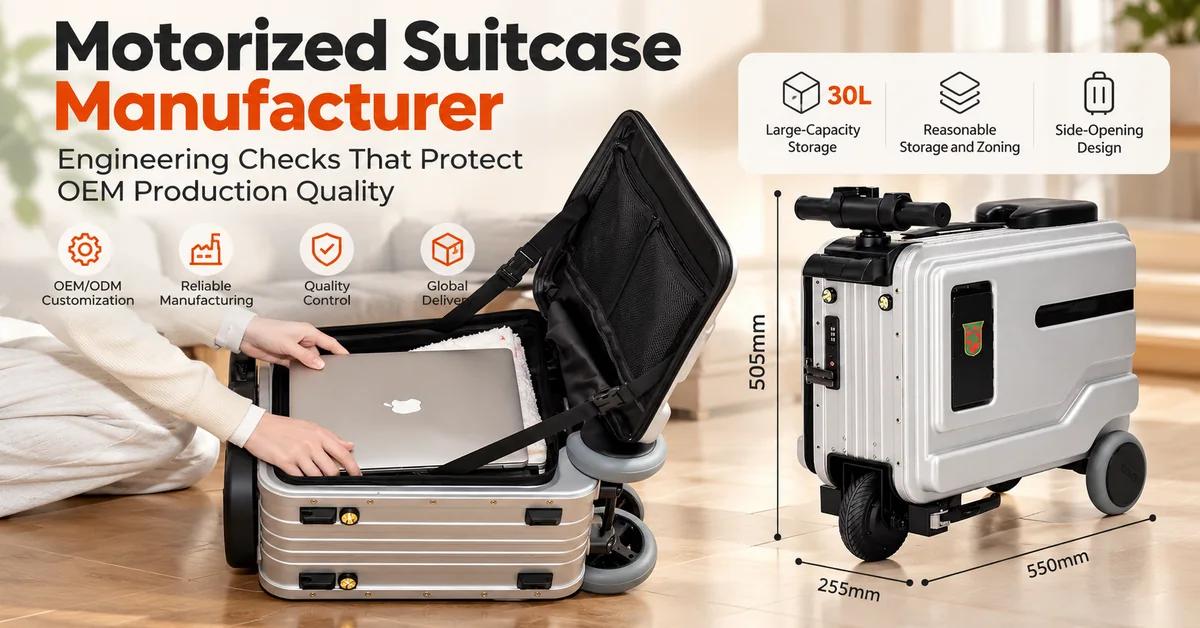
Approximately 30 L |
|
Motor |
Confirm current datasheet |
36 V, 250 W brushless |
|
Battery |
Confirm current datasheet |
Removable, 93.6 Wh |
|
Published maximum speed |
Up to 8 km/h |
Up to 13 km/h |
|
Published maximum load |
110 kg |
120 kg |
|
Charging time |
Approximately 2 hours |
Approximately 2–3 hours |
|
Construction |
Aluminum-alloy frame |
Aluminum alloy and PC |
|
Luggage lock |
TSA combination lock |
TSA combination lock |
Specifications reflect OEASY's published ES1 Pro and ES2 Pro articles and may vary with product revisions or production configurations. Always request the current model-specific technical sheet.
For a comprehensive view, explore all OEASY smart electric luggage products.
4. How OEM and ODM Support Different Purchasing Strategies
Choosing the right development route can significantly affect project complexity.
OEM manufacturing is generally appropriate when the buyer wants to establish a branded product using an existing platform and approved customization options.
ODM development is more appropriate when the buyer requires additional product design, structural modifications, electronic integration, or other engineering work.
OEASY describes an eight-stage product development workflow:
-
Product Concept
-
Industrial Design
-
Engineering Development
-
Prototype
-
Mold Manufacturing
-
Testing
-
Mass Production
-
Global Delivery
The exact steps depend on the project. For example, an existing-platform branding order may not require entirely new molds.
Before production, buyers should approve a representative sample, configuration sheet, packaging requirements, and agreed acceptance criteria.
For detailed manufacturing information, review OEASY's OEM/ODM development process.
5. What Determines the Real Cost of Wholesale Rideable Luggage?
Wholesale pricing is affected by more than the suitcase shell and electric motor.
Key variables include battery configuration, structural components, electronic controls, production volume, surface finishes, packaging, testing requirements, and any new tooling.
For an importer, total landed cost should also account for freight, insurance, customs duties, applicable taxes, inspection costs, and expected warranty obligations.
A useful purchasing model is:
Estimated Landed Cost per Unit = Product Cost + Allocated Tooling and Setup + Logistics + Import Costs + Inspection and Expected After-Sales Costs
All components should be calculated using consistent commercial terms, without double-counting costs already included in a supplier's quotation.
A lower-priced configuration may be appropriate for a value-focused retail market. A more sophisticated platform may justify greater expenditure when its additional functions are meaningful to the intended customer.
For customized electric luggage, request a project-specific cost breakdown rather than assuming one standard wholesale price applies to every configuration.
6. Reducing Sourcing Risks Before a Bulk Order
A disciplined purchasing process can prevent technical and commercial disagreements after production begins.
The recommended sequence is to establish target-market requirements, shortlist appropriate product platforms, review documentation, obtain representative samples, agree on validation criteria, and approve production specifications.
Three controls are particularly useful:
Configuration control: Confirm the motor, battery, controller, housing, packaging, and accessories included in the approved product.
Quality control: Specify the tests, inspection records, and product acceptance requirements needed before shipment.
Commercial control: Document MOQ, payment milestones, tooling arrangements, delivery terms, warranty expectations, and responsibility for engineering changes.
No supplier evaluation can eliminate every risk. However, documented decisions and properly reviewed samples provide a stronger basis for repeat orders.
7. Why Consider OEASY for a Rideable Luggage Sourcing Project?
OEASY is a China-based smart electric luggage brand supported by Hangzhou UNIWISE International Co., Ltd. for international project coordination and Ningbo UNIWISE Precision Machinery Co., Ltd. for engineering and manufacturing.
Its manufacturing-oriented business model connects product selection, mechanical and electrical design, precision component production, assembly, quality coordination, and global delivery support.
For overseas buyers, this provides an opportunity to discuss both existing product platforms and customization projects through a coordinated development process.
OEASY may be particularly relevant to luggage brands, importers, wholesale distributors, and private-label businesses seeking an electric luggage manufacturing partner rather than only a catalog reseller.
Its published capabilities provide a useful starting point for supplier evaluation, while project-specific performance, commercial conditions, certifications, and documentation must still be confirmed.
Learn more about OEASY's company background and manufacturing support.
8. Request a Rideable Luggage Supplier Project Review
A productive supplier conversation begins with a clear purchasing brief.
To receive more relevant product recommendations, share your target sales country, intended distribution channel, expected order quantity, preferred product platform, target price range, customization scope, and desired delivery schedule.
If your project requires battery documents, performance validation, special packaging, or new engineering work, identify these requirements at the initial review stage.
Looking for an electric ride-on luggage manufacturing partner?
OEASY can review your requirements and discuss suitable product platforms, available customization options, and potential next steps for sampling or development.
Explore OEASY Rideable Luggage Models
Request a Wholesale Quote or OEM/ODM Consultation
9. Frequently Asked Questions About Rideable Luggage Suppliers
1. How do I choose a reliable rideable luggage supplier in China?
Evaluate product specifications, manufacturing resources, battery documentation, quality control, sample quality, customization capabilities, and commercial terms. Request verifiable evidence rather than relying solely on supplier descriptions or low quotations.
2. What is the difference between a rideable luggage supplier and a manufacturer?
A supplier may distribute products sourced from another company, while a manufacturer is directly involved in production. Some businesses coordinate both manufacturing and international sales. Verify the actual production responsibilities and engineering resources before ordering.
3. Can I purchase wholesale rideable luggage under my own brand?
Yes. Private-label projects may include logo application, shell colors, packaging, and selected product configurations. OEASY supports OEM and private-label development, subject to the approved project scope.
4. What is the MOQ for OEM electric ride-on suitcases?
MOQ depends on the product platform, customization requirements, materials, and production arrangements. OEASY does not publish one universal MOQ applicable to every project. Buyers should request a quotation based on their specifications and quantity.
5. What technical specifications should I request before purchasing?
Request motor power, battery voltage and Wh rating, storage capacity, weight, dimensions, rated load, speed settings, charging requirements, operating conditions, and available testing documentation for the exact model and configuration.
6. Are electric ride-on suitcases with removable batteries allowed on airplanes?
Not necessarily. Some airlines prohibit rideable electric suitcases regardless of battery removability. Acceptance depends on the airline, device classification, and applicable regulations. Confirm the actual route and carrier policy before making airline-compatibility claims.
7. What quality tests should a rideable luggage supplier provide?
Relevant checks may include incoming materials, assembly, electrical functions, battery performance, load-bearing structures, and finished-product inspections. Specific tests and acceptance thresholds should be established for the purchased model and intended market.
8. Can a manufacturer develop a completely customized rideable suitcase?
An ODM-capable manufacturer may support industrial design, structural engineering, electronic integration, prototyping, tooling, and production. Technical feasibility, development costs, intellectual property arrangements, and production schedules should be agreed before the project begins.
9. How can importers reduce warranty and after-sales risks?
Agree on warranty terms, replacement-parts availability, troubleshooting procedures, defect reporting, and responsibility for repairs before ordering. Verify sample quality and ensure the delivered configuration matches the approved specification.
10. How do I request an accurate bulk quotation from OEASY?
Provide the destination market, target quantity, selected platform, preferred specifications, branding requirements, packaging needs, and delivery expectations through the OEASY contact page. The team can review the project and discuss appropriate next steps.
Conclusion
Selecting a reliable rideable luggage supplier requires a balanced assessment of product compatibility, technical performance, battery documentation, manufacturing resources, quality control, customization, and commercial risk.
For importers and private-label brands, the goal is not simply to obtain the lowest unit price. It is to select a suitable product, confirm its intended-market requirements, establish clear quality expectations, and build a repeatable sourcing program.
OEASY offers four smart electric luggage platforms—ES1 Essential, ES2 Performance, ES3 Executive, and ES4 Versatile—supported by engineering, precision manufacturing, OEM/ODM development, and international project coordination.
Whether you are evaluating an existing ride-on suitcase or planning a customized smart luggage product, start with the technical and commercial requirements that matter most to your market.
Ready to evaluate your next wholesale electric luggage project? Contact OEASY to discuss product selection, customization requirements, and a project-specific quotation.